

Australia's Treasurer, Jim Chalmers, will reveal in the Intergenerational Report to be published on Thursday that Australia's care economy could grow from the current 8% of GDP to around 15% within 40 years.
The report forecasts that Australians will live longer and healthier lives over the next 40 years, but the increase in the elderly population will drive up the demand for care services. By 2062-63, life expectancy is projected to reach 87 years for men (currently 81.3 years) and 89.5 years for women (currently 85.2 years).
Authored by the Treasury Department, the report estimates that although Australia's population growth rate over the next 40 years will be lower than any other 40-year period since its federation, the population is expected to reach 40.5 million by 2062-63.
The Intergenerational Report focuses on the nation's future, examining the impact of demographic changes across a wide range of economic and social sectors. The first report was completed during the Howard government era, with the most recent one in 2021. While these reports play a crucial role in helping policymakers identify trends and highlight impending issues, they are also constrained by the extended timeframes, changing environments, and the inevitability of differing policies.
This year's report once again highlights the economic and budgetary challenges brought by an aging population. The combination of longer life expectancies and low fertility rates means Australia will continue to experience aging trends over the next 40 years. The report notes that the number of people aged 65 and above will more than double, and those over 85 will more than triple, posing ongoing economic and fiscal challenges for Australia.
The Treasury Department indicates in the report that compared to the 1.4% of the past 40 years, the average annual population growth rate for the next 40 years is expected to slow to 1.1%. However, the department forecasts a 15.8% increase in the number of healthcare and social assistance workers from 2021 to 2026. The demand for aged care workers alone is expected to double by 2050.
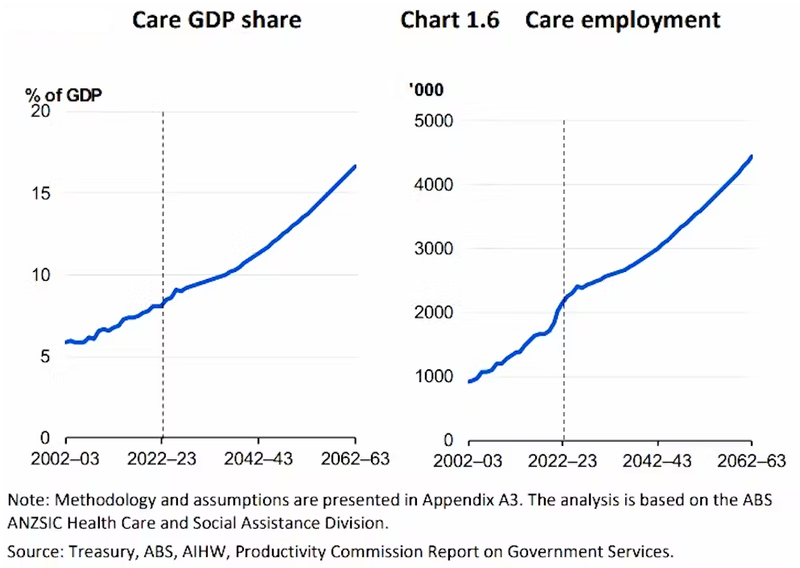
Chalmers states that the growth of the care economy will be one of the most significant changes during this period, with the care sector playing a larger role in driving growth. Whether it's healthcare, aged care, disability, or early childhood education, Australia will need more well-trained workers to meet the growing demand for high-quality care over the next 40 years, potentially making it the sector with the most job creation opportunities in the future economy.
The Intergenerational Report expects that while cumulative net overseas migration will not return to pre-pandemic levels until 2029-2030, over the next 40 years, net overseas migration is expected to account for 0.7 percentage points of Australia's average annual population growth.
In terms of government budget pressures, the report follows the inherent pattern that the five major long-term expenditure pressures are health and aged care, national pensions, defense, and interest payments on government debt. Over the 40 years from 2022-23 to 2062-63, these categories of expenditure are expected to collectively increase by 5.6 percentage points of GDP.
Regarding Australia's long-stagnant productivity, the report suggests paying more attention to recent history to better reflect the challenges of productivity growth, such as the continuous structural change in the service sector, the costs associated with climate change, and diminishing returns from past reforms. The Intergenerational Report identifies areas to improve productivity growth, including reforms to reduce barriers to business entry and existence, promoting technology diffusion, and encouraging labor mobility. It also highlights the potential of digital innovations, including artificial intelligence.
In terms of human capital, the report states that future jobs will require increasingly specialized skills and have the potential to support Australians at all stages of human capital development. The Australian government should guide infants and toddlers in developing basic skills such as literacy and numeracy, which will help participate in the expanding knowledge economy over the next 40 years.
Meanwhile, the Business Council of Australia has released a reform plan called “Productivity Slump” aimed at reversing Australia's “productivity slump” and boosting competitiveness. Among several recommendations, the BCA suggests a focus on broad reform of the tax system to minimize distortions and increase incentives for investment, innovation, and hiring.
The Intergenerational Report also advises the Australian government to commit to a “national net-zero emissions road map by 2050,” based on a 10-year plan. The report calls on the government to take further action to increase women's economic participation, establish more flexible labor relations, and set a microeconomic reform agenda.