
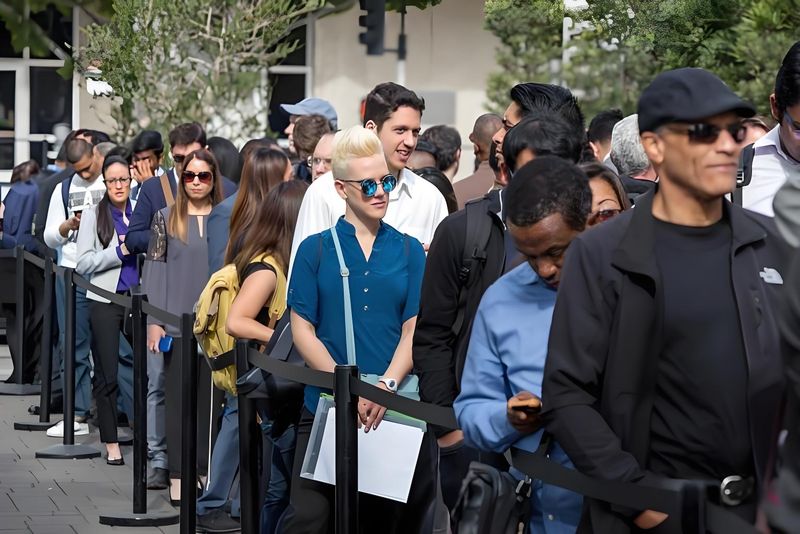
Weak Job Market Raises Concerns
Recently, the American economic community has shifted its focus to the weakening labor market. In its latest research, BCA Research points out that while consumption among the wealthy remains strong, the weak job market has become the current economy's biggest "pain point." The agency analyzes that job growth in the U.S. has approached the brink of "stalling," which could be a precursor to a broader economic slowdown.
Originally an aviation term, "stalling" refers to an aircraft suddenly losing lift and dropping. Applied to the economic level, it means insufficient job creation, which could drag down overall growth momentum.
Rich People’s Spending Cannot Support the Economy Alone
Currently, the top 10% income earners contribute about half of consumer spending, a seemingly large share, but BCA Research believes that high-income groups cannot support the economy single-handedly.
First, although the wealthy hold a larger share of income, their propensity to consume (the percentage of income spent) is often lower than that of middle- and low-income families, leading to limited marginal consumption contributions. Secondly, if the job market continues to slow, the spending decline among a large number of middle- and low-income individuals will weaken the overall consumption base. Finally, the spending of the wealthy is more directed toward financial assets and luxury goods, areas with limited impact on overall economic growth.
Multiple Effects of Weak Job Market
A weakening job market not only weakens household income but also transmits through confidence channels to affect consumption and investment. Data shows that recent non-farm payroll additions have fallen short of market expectations, and the unemployment rate is gradually rising. If this trend continues, it will dampen consumer spending willingness and could negatively impact real estate and durable goods consumption.
BCA Research emphasizes that the risk of slowing job growth should not be underestimated. Once the labor market is under comprehensive pressure, even stock market gains boosting some household wealth cannot offset the negative effects of widespread job declines.
Institutional Views and Market Concerns
Some economists believe that the U.S.'s over-reliance on high-income groups' spending as a growth engine harbors risks. Although the wealthy have more disposable income, their consumption habits are stable and tend to be dispersed, unable to provide a "counter-cyclical" push in economic downturns. In contrast, spending by the middle class and low-income groups is more crucial to the economic cycle.
Analysts further point out that if the job market continues to slump, the Federal Reserve may face a greater policy dilemma. On one hand, inflationary pressure has not completely subsided; on the other hand, job market weakening requires monetary policy to remain accommodative.
Outlook
In the future, whether the U.S. economy can avoid further slowdown will largely depend on the recovery of the job market. Institutions generally believe that if the trend of stagnant hiring persists, consumption growth will be difficult to sustain, thereby dragging down overall economic performance.
BCA Research's conclusion is quite cautionary: relying on the spending of the wealthy cannot solve structural problems; the U.S. economy needs broader, more balanced job growth to maintain long-term stability.

