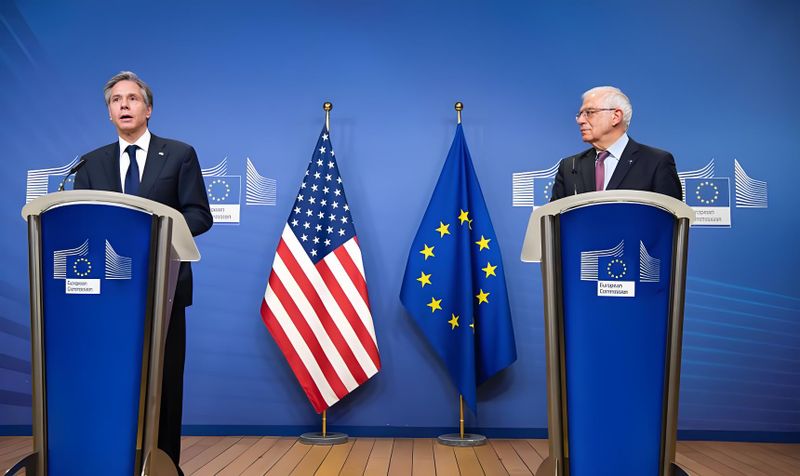
Resilience of US-EU Trade
At a recent hearing in the European Parliament, Sabine Weyand, Director-General for Trade at the European Commission, stated that the US's imposition of a 15% tariff on EU imports has not disrupted transatlantic trade. Weyand emphasized that while the increased tariff has indeed raised prices for certain goods, the overall trade relationship remains smooth.
She noted that the so-called "tipping point" has not been reached—where tariffs are high enough to sever trade. At current levels, the exchange of goods between the US and EU remains robust, especially in key sectors such as machinery, pharmaceuticals, and high-tech equipment, which continue to show growth momentum.
Compromise Background of the Agreement Framework
In late July, the EU reached a framework agreement with the Trump administration to combine the previous 10% general tariff and 4.8% most-favored-nation tariff into a unified 15% tariff on all EU goods. This arrangement was considered a "lesser of evils" in negotiations. Weyand reminded the parliamentarians that this setup, though not ideal, is a pragmatic choice compared to Trump’s initial threat of a 30% high tariff.
She urged the European Parliament to support the removal of EU tariffs on US manufactured goods, fulfilling obligations under the mutual agreement and avoiding further trade friction.
Divergent Industry Impact
While overall trade has not been severely hit, Weyand acknowledged that some industries face greater pressures. The most notable is the automotive industry, where the applicable tariff rate of 27.5% has significantly undermined European car manufacturers' competitiveness in the US market. In contrast, exports in sectors like pharmaceuticals, aviation, and green energy equipment have maintained growth, highlighting industry resilience and differentiated market demand.
Analysts believe the US's inability to fully rely on domestic production to meet demand is a key reason for the stability of bilateral trade. This implies EU goods still hold an irreplaceable position in the US market.
EU Position and Outlook
During the hearing, Weyand stated that the EU needs to assess its relative position in the global competitive landscape. She emphasized that the actual competitiveness of EU goods depends not just on tariff levels, but also on comparisons with other economies. If the US imposes higher tariffs on other countries, the EU's 15% rate could become an "advantage" in relative terms.
She added, "The core of trade negotiations is to weigh alternatives. In the current environment, we must acknowledge that the possibility of trading with the US solely under traditional most-favored-nation treatment no longer exists."
Analysis and Risk Warnings
Experts note that while the US-EU agreement has temporarily eased tariff impacts, long-term uncertainty remains. On one hand, the complex political environment within the US could lead to a tightening of future tariff policies; on the other, there are divisions within the EU, with some member states concerned about the erosion of industrial competitiveness.
Moreover, if the US and EU encounter disagreements in emerging fields like the digital economy and green subsidies, tariffs might once again be used as a negotiating tool, further disrupting the existing balance.
Conclusion
Overall, signals from EU trade officials indicate that while US-EU relations are fraught with friction, the foundation of transatlantic trade remains resilient. The 15% uniform tariff has yet to trigger systemic barriers, and the future trajectory will depend on whether both sides can find a new equilibrium between political maneuvering and market demand.