
• Home
  • Categories
  • News
  • Community
EN
EN
Home
CategoriesNewsGlossaryCommunityAbout Us
Contact Us
Social Media
Region
🌏International
Region
🌏International

Copyright © 2023-2026 Traderknows Ltd. All rights reserved.

Contact
Home
/
News
/
The influx of tourists stimulates the rapid expansion of Japan's service industry.

The influx of tourists stimulates the rapid expansion of Japan's service industry.

TraderKnowsTraderKnows
2024-05-09
Summary:Supported by inbound tourism activities, Japan's service industry not only expanded at its fastest pace in three months but also formed a stark contrast with the contraction in manufacturing activity and low business confidence.

On Tuesday, Japan's August service sector Purchasing Managers' Index (PMI) final figure rose from 53.8 in July to 54.3, marking the 12th consecutive month above the boom-bust line of 50. The index that measures backlogs of work rebounded to above 50.0 in August. Data indicates that bolstered by inbound tourism activity, Japan's service sector not only expanded at the fastest pace in three months but also contrasted sharply with the shrinking manufacturing activity and the gloom in business confidence.
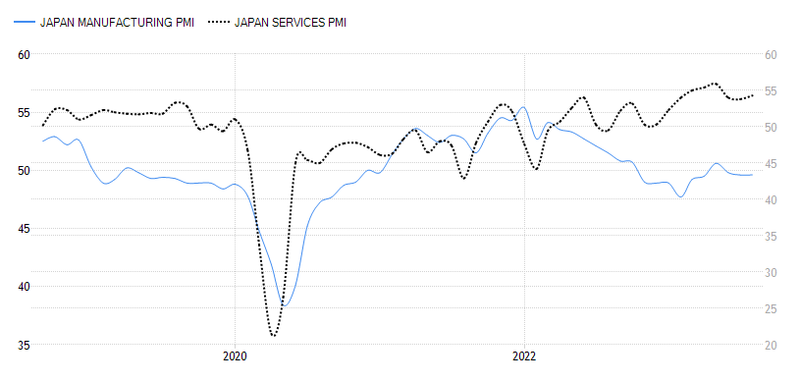
Japan PMI

S&P Global Market Intelligence economist Usamah Bhatti remarked that Japan's service companies saw a significant improvement in new orders, supporting the accelerated growth of business activity. Service providers' signals of steeply increasing inflation pressures highlight the broader price pressures faced by Japan's business sector.

Respondents noted that due to the increase in inbound tourists, customer numbers, and demand for goods and services, service providers are inclined to hire more staff to meet the flourishing demand for goods and services. Data shows that the number of visitors to Japan in July reached 2.32 million, the highest level since the pandemic began.
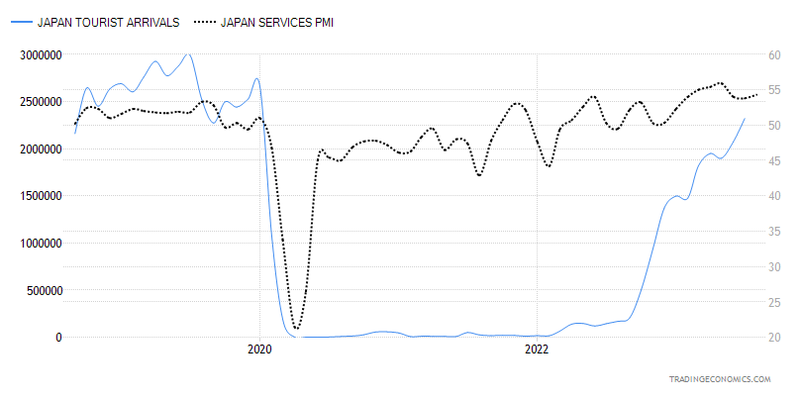
Tourism and PMI

However, impacted by the surge in demand for goods and services and the accelerated growth of business activity, Japanese household spending experienced its largest drop in over two and a half years. Official data released on Tuesday showed that Japan's household spending in July decreased by 5.0% year-over-year, surpassing the market’s expected median decline of 2.5% and marking the fifth consecutive month of decline. Seasonally adjusted household spending fell by 2.7% month-over-month, against expectations of a 0.5% increase.

An official from Japan's Ministry of Internal Affairs and Communications mentioned that, although the lifting of pandemic control measures has increased outings, boosting spending in dining, transportation, culture, and entertainment services, the broad rise in prices led to decreased spending in many areas, especially in housing and automobiles, where prices are more volatile.

Japan's core consumer price index (CPI), excluding fresh food but including petroleum products, followed a 3.3% increase in July with another rise of 3.1% in August, marking the 16th consecutive month the index has been above the Bank of Japan's inflation target of 2%.

Economist Masato Koike of Sompo Institute Plus expects that with further wage growth and normalization of economic activities, private consumption will continue to recover. This view is supported by a private survey showing Japan's service sector activity expanding at the fastest pace in three months in August.

Risk Warning and Disclaimer

The market carries risks, and investment should be cautious. This article does not constitute personal investment advice and has not taken into account individual users' specific investment goals, financial situations, or needs. Users should consider whether any opinions, viewpoints, or conclusions in this article are suitable for their particular circumstances. Investing based on this is at one's own responsibility.

The End
Previous
Next
Comments
0/1000
TraderKnows
Written byTraderKnows
Created date:2023-09-05 05:50
Last Updated:2024-05-09 01:57
Independent Analysis: Manually researched and fact-checked by the TraderKnows Compliance Team, based on public regulatory records.
Wiki
CPI

The Consumer Price Index (CPI) refers to an economic indicator that measures the change in prices of consumer goods and services over a period of time.

Recent Post

Trump Invokes Defense Production Act with 850 Million USD for Coal Power to Meet AI Demand

7 hours ago

NY Fed Index Shows High Supply Chain Pressures as Geopolitical Conflicts Raise Global Inflation Con…

7 hours ago

Japan's Real Wages Rise for Fourth Consecutive Month, Fueling June BOJ Rate Hike Bets

7 hours ago

China Flexible Employment Exceeds 300 Million as Blue-Collar Wage Growth Outpaces White-Collar for…

7 hours ago

South Korean Stocks Post Steepest Weekly Drop Since March as Tech Valuations Reset

7 hours ago

China Commercial Paper Rates Drop in Early June Amid Rising Bank Demand

7 hours ago

UK House Prices Unexpectedly Fall in May as Geopolitical Tensions Push Up Borrowing Costs

7 hours ago

Massive Intervention Fails to Save Yen as Short Positions Surge Near Historic Lows

7 hours ago

AI Momentum Pauses as Broadcom Outlook Misses High Expectations; Markets Await Payrolls

7 hours ago

SpaceX Launches 75B USD IPO Roadshow as Access Blocked in Mainland China and Hong Kong

7 hours ago

Global Gold ETFs See $2 Billion Outflows in May as Capital Pivots to Tech Assets

7 hours ago

Nikkei Drops Over 1% on Tech Sector Pullback While Real Wage Growth Provides Support

8 hours ago

South Korea Lifts Mandatory Reporting for Crypto Transfers Over 10M Won

8 hours ago

Amundi Says Asian AI Stocks Supported by Fundamentals as Fed Path Poses Key Risk

8 hours ago

Taiwan Stocks Close 1.33% Lower on Broadcom Drop But Hold Key Technical Support

8 hours ago

Risk Warning

TraderKnows is a financial media platform, with information displayed coming from public networks or uploaded by users. TraderKnows does not endorse any trading platform or variety. We bear no responsibility for any trading disputes or losses arising from the use of this information. Please be aware that displayed information may be delayed, and users should independently verify it to ensure its accuracy.