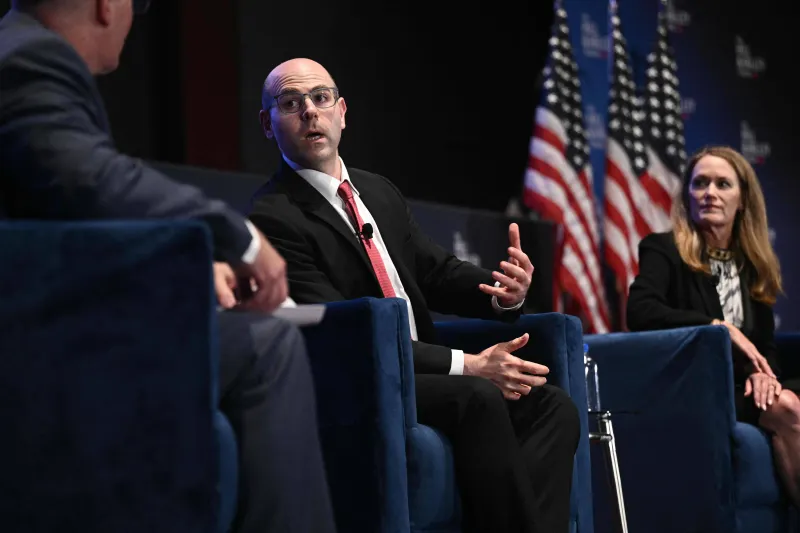
Milan Speaks Out: Maintaining a Relaxed Pace to Return to "Neutral" Quickly
After two consecutive rate cuts of 25 basis points each, Federal Reserve Board member Stephen Milan once again publicly stated that a continued rate cut at the final meeting of the year "remains reasonable." He emphasized that the policy goal remains unchanged, with the key aim being a quicker return to a "neutral range" that neither stimulates nor restrains. Compared to his colleagues' more cautious tone, Milan's stance aims to provide operational continuity for the easing path.
Judgment in a Data Vacuum: Weakening Inflation, Moderate Employment
Due to the government shutdown, official macro statistics were interrupted, causing decision-makers to rely more heavily on private data and enterprise surveys. Milan pointed out that recent price increases were lower than previously expected, employment expansion remains moderate, and wage growth is slowing, all pointing to the conclusion that interest rates should be lower than current levels. Although the "chain of evidence" is still incomplete, he believes that continuing the established path is more consistent until new information emerges that could overturn predictions.
Internal Disagreements Intensify: December "Whether to Lower Again" Still Undecided
Unlike Milan, some officials have concerns about inflationary persistence and policy timing, advocating patience until data resumes to avoid "premature easing." Some members suggested evaluating the employment protection effects of the previous two cuts before deciding on additional action. As a result, the December meeting's rate decision will be more dependent on high-frequency information and private surveys closer to the time, increasing uncertainty in the path forward.
Market Trends: Rate Cut Probability Swings with Data, Dollar and Gold "See-Saw"
Amid the push-pull of "another cut" bets and cautious statements, the implied probabilities in federal fund futures are experiencing heightened volatility. If employment and inflation readings continue to marginally decline, the market may quickly revise up rate cut expectations, with long-term yields and real interest rates falling in tandem; conversely, if private employment proves unexpectedly resilient, dollar momentum may persist, pressuring precious metals and interest-sensitive assets. The pricing logic is shifting from "linear easing" to "evidence-dependent."
Policy Implications: Rebalancing Risk Management Framework and Communication
Milan's advocacy for a "faster return to neutral" stands alongside cautious factions emphasizing "waiting for verifiable data," highlighting a rebalancing of the risk control framework: avoiding high interest rates dragging down the real economy and credit markets while preventing inflation expectations from resurfacing. Future communications are likely to focus on three points—wage stickiness, service inflation, and labor demand—to enhance the verifiability of policy forward guidance.
Risk List: Three Major Uncertainties Still Need Vigilance
First, the pace of data recovery. If the resumption of official statistics is delayed, it will be harder to reconcile policy differences.
Second, the slope of inflation's retreat. If the slowdown in service inflation and rent stickiness is less than expected, the threshold for rate cuts will be passively raised.
Third, financial conditions. If the stock, bond, and foreign exchange markets loosen excessively at once, it could weaken policy constraints and amplify asset volatility.
December as a Tone-Setting Window, "Mini Non-Farm" and Other High-Frequency Readings in Focus
Amid the temporary absence of official data, private employment and price surveys will become key references. If subsequent readings and enterprise guidance jointly point to a cooling of demand and easing inflation, Milan's advocacy for "continued rate cuts" may gain majority support; conversely, decision-makers may opt to hold steady, awaiting a clearer chain of evidence. Regardless of the approach, the year-end meeting will set the tone for interest rate paths and financial conditions for the first half of next year.