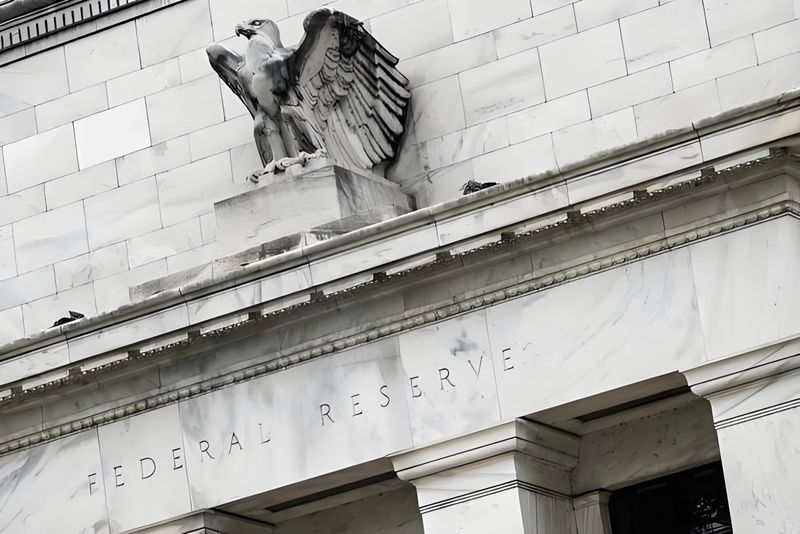
Wall Street Consensus: QT Endpoint May Arrive Early
Against the backdrop of heightened global financial market attention, both JPMorgan and Bank of America have released recent forecasts this week, predicting that the Federal Reserve will officially announce the end of its Quantitative Tightening (QT) policy at next week's policy meeting. This signifies that the two-year balance sheet reduction cycle may conclude early, marking a transitional shift in liquidity policy.
Previously, most institutions anticipated QT would end in December or early 2025, but the recent increase in pressure on the U.S. dollar financing market has accelerated a revision of policy expectations. Analysts point out that the continuous decline of bank reserves to critical levels is the direct reason the Federal Reserve has to reassess the pace of balance sheet reduction.
Bank Reserves Approaching "Safety Red Line"
The latest data from the Federal Reserve shows that as of the week ending October 22, U.S. banking system reserves fell to $2.93 trillion, the lowest level this year, further decreasing by $59 billion compared to the previous week. The market generally believes this data is approaching the "adequate reserves" threshold defined by the Fed.
Reserves are a core indicator of the banking system's stability, and once they fall below a safe range, money market rates often spike, causing systemic tension. Recently, the Overnight Reverse Repurchase (ON-RRP) tool's balances have nearly emptied, indicating that market liquidity is further tightening.
JPMorgan analysts indicate that the trend of declining reserves suggests the financial system is entering a liquidity-sensitive zone, and failure to intervene timely might lead to a "liquidity squeeze" akin to the 2019 repo market.
Increased Rate Fluctuations, Rising Financing Pressure
Recently, U.S. money market rates have been climbing. Since mid-October, overnight repo rates have frequently hit upper bounds, reflecting a surge in short-term financing demand. Analysts believe that the Treasury's rebuilding of cash reserves and increased issuance of treasury bonds are drawing liquidity out of the Federal Reserve's system.
A report from Bank of America points out that the current repo rate levels should sound an "alarm" for the Federal Reserve, indicating that excess bank reserves are depleting rapidly. The report states: "As reserves approach a critical point, minor fluctuations in the financing market may trigger a chain reaction."
Powell Hints at "Approaching Turning Point"
Earlier this month, Federal Reserve Chair Powell stated that the reduction process would halt when bank reserves are slightly above "adequate levels," seen as an indication that the endpoint is near. Powell noted that while the current balance sheet size has room for reduction, it may reach a reasonable range "in the coming months."
Analysts believe Powell's wording reflects the Federal Reserve's cautious stance. Although the market generally anticipates next week's policy meeting will discuss both rate cuts and balance sheet reduction, the policy focus is gradually shifting from curbing inflation to maintaining liquidity stability.
TD Securities strategists stated: "If reserves continue to decline, the Federal Reserve may choose to immediately stop QT to prevent fluctuations in the market funding chain."
Ending QT May Signal a Policy Shift
QT (Quantitative Tightening) is a measure implemented by the Federal Reserve to tighten liquidity and control inflation by reducing the balance sheet. Since its launch in 2022, the size of the Fed's balance sheet has dropped from nearly $9 trillion to $6.6 trillion. However, with easing inflation pressures and slowing economic growth, the risks of continuing the balance sheet reduction are rising.
Analysts point out that the end of QT does not imply a full shift to loose monetary policy but marks a critical step by the Federal Reserve in balancing inflation and liquidity.
Barclays' recent report stated: "At this stage, the biggest concern for the Federal Reserve is not out-of-control inflation but the market turmoil caused by a sharp drop in liquidity."
Focus on Next Week's FOMC Meeting
Market participants generally believe that next week's FOMC meeting will become the most pivotal policy event of the year. Besides a possible 25-basis-point rate cut, the meeting might clarify the path to ending QT.
If the Federal Reserve confirms the end of QT, short-term funding market volatility is expected to stabilize, the Dollar Index may face downward adjustment, while gold and U.S. Treasury prices stand to benefit.
Overall, Wall Street has already sounded the alarm for a "liquidity shift." Regardless of the final decision, next week's Federal Reserve statement will redefine the logic of risk pricing for global markets.