
• Home
  • Categories
  • News
  • Community
EN
EN
Home
CategoriesNewsGlossaryCommunityAbout Us
Contact Us
Social Media
Region
🌏International
Region
🌏International

Copyright © 2023-2026 Traderknows Ltd. All rights reserved.

Contact
Home
/
News
/
Nearly half of Japanese companies are concerned about central bank policies affecting financing.

Nearly half of Japanese companies are concerned about central bank policies affecting financing.

TraderKnowsTraderKnows
2024-05-07
Summary:A Reuters survey revealed that 40% of Japanese companies expect recent central bank policy changes to impact their financing, showing how sensitive they are to central bank policy shifts after years of easing measures.

On Wednesday, a survey published by Reuters revealed that about 40% of Japanese companies expect the central bank's recent policy adjustments to impact their financing. This underscores the sensitivity of Japanese businesses to changes in central bank policies and financing conditions, following years of expansive monetary easing.

There are indications that the Bank of Japan might be preparing to exit its ultra-loose monetary policy, heightening pressures on borrowing costs for the world's third-largest economy. This marks a significant shift from decades of ultra-low interest rates, as suggested by a manager of an electronics company, who stated that the central bank's policy adjustments would stimulate a rise in financing costs, implying future increases in corporate debt interest rates and possibly leading to a deterioration in companies' cash flows.

Since the 1980s and 1990s, influenced by the burst of the real estate and asset price bubble, Japan's economy has been in a state referred to as "the lost three decades." Over these decades, due to a lack of economic vitality, stagnant wage growth, and persistently low inflation, the Bank of Japan's official interest rates have remained at extremely low levels.
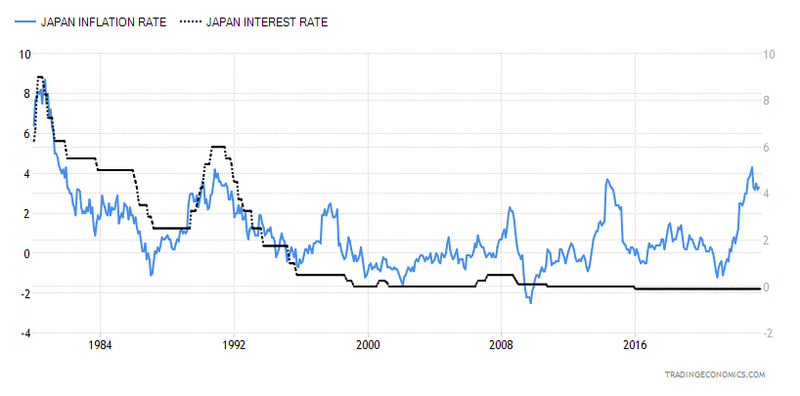
Japanese Interest Rates and Inflation

Last month, despite the Bank of Japan's continued adherence to its Yield Curve Control (YCC) policy, it widened the fluctuation range for 10-year government bond yields, adapting to the evolving inflation situation and economic growth prospects. This move is seen by financial institutions and Japanese businesses as a harbinger of the central bank's impending shift from its decades-long low interest rate policy.

A monthly survey of 503 Japanese large and medium-sized non-financial companies by Reuters showed that 7% of the businesses expect to be impacted by the end of this fiscal year in March, while 34% believe their financing will be affected in the next fiscal year. A manager from a service industry company mentioned that while the impact of financing costs is limited for leading companies, it creates significant pressure on small and medium-sized enterprises (SMEs).

The survey also revealed that despite concerns over China's economic slowdown, China remains an important market for Japanese businesses. About 82% of the respondents expect China's importance to their future business to remain as it is. A manager from a machinery manufacturing company noted that although the downturn in China's economy has not yet resulted in a decrease in orders for production equipment, the impact on the automotive supply chain is particularly severe, highlighting the challenges Japanese automakers face in China.

As demand declines and potential financing costs rise, Japanese businesses face more severe price competition in the Chinese market. Some Japanese firms stated that they cannot compete on price with Chinese companies in dual-use products. To maintain competitiveness in the Chinese market, about half of the respondents said they would strengthen price negotiations with local suppliers.

Risk Warning and Disclaimer

The market carries risks, and investment should be cautious. This article does not constitute personal investment advice and has not taken into account individual users' specific investment goals, financial situations, or needs. Users should consider whether any opinions, viewpoints, or conclusions in this article are suitable for their particular circumstances. Investing based on this is at one's own responsibility.

The End
Previous
Next
Comments
0/1000
TraderKnows
Written byTraderKnows
Created date:2023-08-17 02:53
Last Updated:2024-05-07 07:19
Independent Analysis: Manually researched and fact-checked by the TraderKnows Compliance Team, based on public regulatory records.
Wiki
Base Rate

The interest rate set by the central bank serves as the foundation for banks and other financial institutions to calculate their own rates and interest.

Recent Post

Trump Invokes Defense Production Act with 850 Million USD for Coal Power to Meet AI Demand

06-05

NY Fed Index Shows High Supply Chain Pressures as Geopolitical Conflicts Raise Global Inflation Con…

06-05

Japan's Real Wages Rise for Fourth Consecutive Month, Fueling June BOJ Rate Hike Bets

06-05

China Flexible Employment Exceeds 300 Million as Blue-Collar Wage Growth Outpaces White-Collar for…

06-05

South Korean Stocks Post Steepest Weekly Drop Since March as Tech Valuations Reset

06-05

China Commercial Paper Rates Drop in Early June Amid Rising Bank Demand

06-05

UK House Prices Unexpectedly Fall in May as Geopolitical Tensions Push Up Borrowing Costs

06-05

Massive Intervention Fails to Save Yen as Short Positions Surge Near Historic Lows

06-05

AI Momentum Pauses as Broadcom Outlook Misses High Expectations; Markets Await Payrolls

06-05

SpaceX Launches 75B USD IPO Roadshow as Access Blocked in Mainland China and Hong Kong

06-05

Global Gold ETFs See $2 Billion Outflows in May as Capital Pivots to Tech Assets

06-05

Nikkei Drops Over 1% on Tech Sector Pullback While Real Wage Growth Provides Support

06-05

South Korea Lifts Mandatory Reporting for Crypto Transfers Over 10M Won

06-05

Amundi Says Asian AI Stocks Supported by Fundamentals as Fed Path Poses Key Risk

06-05

Taiwan Stocks Close 1.33% Lower on Broadcom Drop But Hold Key Technical Support

06-05

Risk Warning

TraderKnows is a financial media platform, with information displayed coming from public networks or uploaded by users. TraderKnows does not endorse any trading platform or variety. We bear no responsibility for any trading disputes or losses arising from the use of this information. Please be aware that displayed information may be delayed, and users should independently verify it to ensure its accuracy.