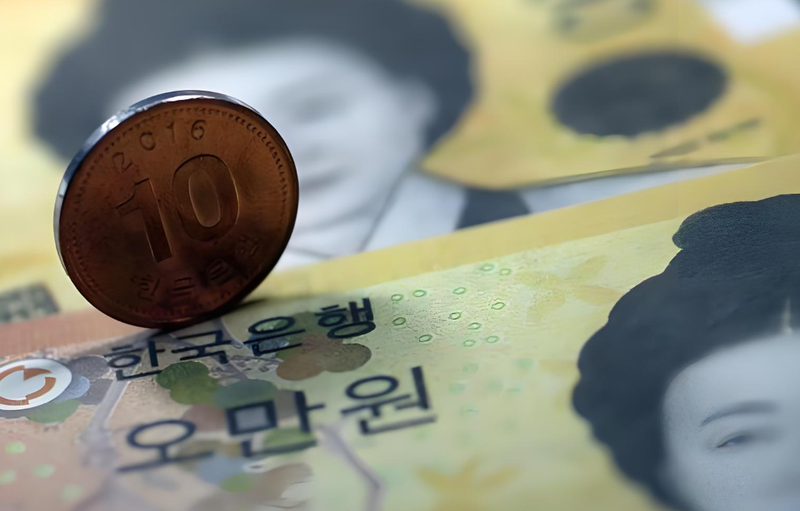
Korean Won Soars, South Korean Government Signals "Firm Determination"
On December 24, 2024, the Korean won exchange rate quickly rebounded, demonstrating strong resilience after South Korean authorities announced several new measures to stabilize the foreign exchange market. The Bank of Korea and the Ministry of Finance released a joint statement indicating that an excessively weak won is detrimental to the economy, and the government's "firm determination" will soon be evident in the foreign exchange market. Following this announcement, the won surged by 1.4% in the short term, rising from 1 dollar to 1485 won to 1 dollar to 1460 won, marking a noticeable recent rebound.
Previously, the won exchange rate had fallen to its lowest point since the 2009 global financial crisis. The government's stance against the excessive depreciation of the won has become clearer, and they have stated they will take urgent measures to address current exchange rate fluctuations, especially amidst the gloomy market sentiment and a strong dollar.
South Korean Government's Determination to Tackle Won Depreciation
The Korean Ministry of Finance and the Central Bank have disclosed that they have held multiple meetings over the past two weeks to discuss the weakening won's issue and jointly seek effective market intervention strategies. The won's depreciation has not only affected consumer purchasing power but has also increased import costs, putting pressure on the economy. The Korean authorities reiterated that the current exchange rate fluctuations extend beyond fundamental factors, and the government will take decisive action when necessary to stabilize market expectations.
In addition, the Korean Ministry of Finance announced new tax measures to support foreign exchange market stability. These measures include strengthened foreign exchange market regulation and more flexible tax policies to mitigate the negative impact of exchange rate fluctuations on the economy. This policy indicates that the government aims to restore investor confidence through increased market intervention and prevent further won depreciation.
Analysis of Korean Won Exchange Rate Fluctuations
In recent months, the won has faced considerable depreciation pressure. Especially amidst a strong dollar, the won's exchange rate has shown significant weakness. The continued depreciation of the won against the dollar brought the exchange rate close to its lowest level since the 2009 financial crisis, attracting widespread market attention. Market analysis suggests that the won's depreciation is related not only to the strong dollar but also to global economic uncertainty, changes in the international trade environment, and shifts in investor sentiment.
The Korean economy has been impacted by both the global economic slowdown and rising import prices. Won depreciation has exacerbated these issues, especially with rising energy and raw material prices, increasing import costs and presenting greater burdens to businesses and households. Therefore, the Korean government considers that taking decisive policy action to stabilize the exchange rate and restore economic momentum is a pressing priority.
Prospects and Challenges of Policy Intervention
Despite the South Korean government's measures to stabilize the exchange rate, the future trajectory of the won remains uncertain. The foreign exchange market is influenced by various factors, including changes in global monetary policy, fluctuations in international market demand, and geopolitical risks. The Korean government faces multiple complex challenges in addressing exchange rate volatility. Firstly, the ongoing global economic uncertainty may impact the stability of the foreign exchange market. Secondly, the strong dollar remains a primary factor in the won's depreciation, and whether the Korean Central Bank can effectively control the won's depreciation depends on the international market's response.
However, the Korean government's resolute attitude and policy adjustments undoubtedly provide market confidence. In situations of excessive exchange rate volatility, decisive government action will be an important step in restoring market trust. Whether the government can continue to intervenes effectively in the foreign exchange market and maintain stable economic growth remains the focus of market attention.
Can the Government Stabilize the Exchange Rate?
Overall, South Korean authorities have exhibited strong determination in facing the pressure of the won's depreciation. With the government implementing more measures to stabilize the market, stability is expected to gradually return. However, the global economic situation remains complex, and the risk of exchange rate fluctuations persists. The future viability of the Korean government's sustained policy intervention to ensure that the won exchange rate remains within a reasonable range will require further observation.