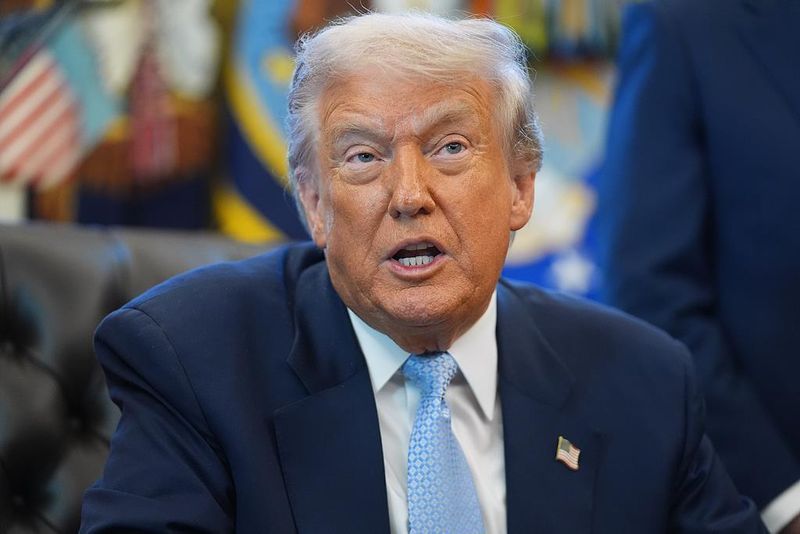
Trump Claims Peace Agreement 'Very Close', Europe Remains Cautious
On the 25th local time, U.S. President Trump publicly stated that a peace agreement for the Russia-Ukraine conflict was "very close to being reached," drawing significant international attention. However, unlike the optimistic remarks from the U.S., some European leaders remain highly skeptical about the progress, noting that the current situation still contains many uncertainties.
According to the White House, Trump's judgment is based on "substantive progress" achieved through recent intensive consultations between the U.S. and Ukraine. However, European countries generally emphasize that key provisions involve regional security architecture and that any agreement must be carefully assessed for its long-term impact.
U.S. Admits Agreement Still Has Sensitive Details Requiring Further Negotiation
White House Press Secretary Levitt stated on the 25th that the latest U.S.-proposed peace framework is nearing its final form, though there are still "some subtle and complex details to be addressed," involving issues like provision language, execution mechanisms, and future security guarantees.
She noted that these challenges are not insurmountable but will require further consultations among Ukraine, Russia, and the U.S. The U.S. emphasizes that to make progress towards a final agreement, it must be actionable and consider the security interests of all three parties.
An American official earlier disclosed that Ukraine has "in principle" agreed to the latest draft of the agreement, although certain provisions still require further technical refinement.
Ukraine Confirms Core Terms Agreed, But Detailed Discussions Continue
Ukraine also confirmed that significant progress has been made in the negotiations. Secretary of the National Security and Defense Council of Ukraine, Mr. Umerov, stated that the U.S. and Ukrainian delegations have reached a consensus on the "core terms" discussed in Geneva, indicating no fundamental disagreements on the main direction of the talks.
However, he also emphasized that Ukraine would not accept arrangements that weaken its sovereignty and that all compromises must enhance its security and strength. This statement shows Ukraine's cautious approach to the agreement, unwilling to make excessive concessions on key issues.
U.S. Peace Plan Reduced from 28 to 19 Points, Controversial Clauses Left for Top Leaders
U.S. media previously revealed that the Trump administration's original peace plan contained 28 points, covering sensitive issues such as non-aggression treaties, Ukrainian military restrictions, future geopolitical positioning, and NATO-related commitments.
However, during the U.S.-Ukraine talks from the 23rd to 24th, the plan was significantly revised and reduced to 19 points. Several U.S. media outlets reported that the most controversial clauses were temporarily set aside for final decision-making by the U.S. and Ukrainian Presidents.
Experts state that the substantial adjustment of the plan reflects the difficulty for the U.S. and Ukraine to immediately reach a consensus on some aspects, while also showing Washington's efforts to balance the agreement without overly favoring either side, to gain broader international support.
European Leaders Still Hold Reservations
Despite the stronger willingness shown by both U.S. and Ukrainian sides compared to before, many European leaders remain reserved about the progress of the agreement. They worry that without clear security guarantees and implementation monitoring mechanisms, the agreement might not lead to genuine stability.
Moreover, the fact that issues related to the European security architecture are designated by the U.S. as "separately negotiated items" further prompts European countries to seek increased involvement in the next stage of negotiations.
Despite Breakthrough, The 'Final Kilometer' Remains Uncertain
Overall, the Russia-Ukraine peace talks have indeed shown new signs, but significant hurdles still remain before reaching a final agreement. A complete consensus on key security issues has yet to be formed among the three sides, and the political judgments and decisions of leadership will determine whether this process can truly advance to its conclusion.