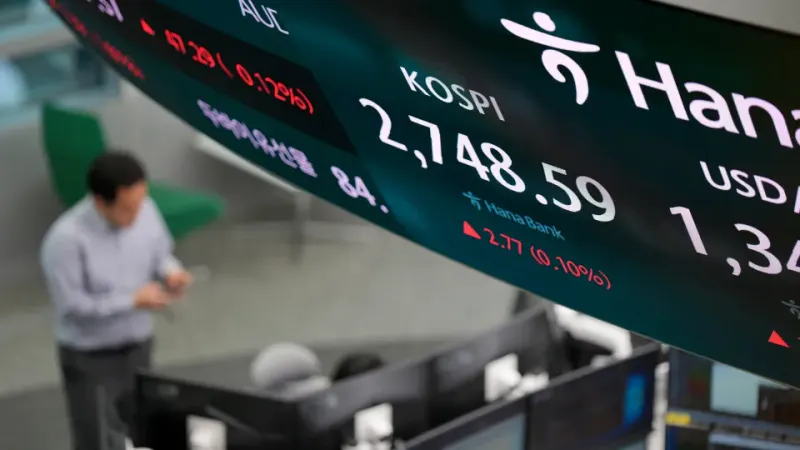
Index Plummets, Psychological Threshold Breached
On Wednesday, South Korean stocks faced an unusual sharp drop this year, with the Kospi index plummeting as much as 6.2% intraday, falling below the critical psychological level of 4000 points, ending its previous high-level sideways trend. Heavyweight stocks led by Samsung Electronics and SK Hynix collectively came under pressure, pulling the index down further from its historic high. The futures index fell simultaneously, with the Kospi 200 index futures dropping over 5% at one point, triggering a five-minute trading halt for programmed sell orders by the exchange.
Technology-Defense-Shipbuilding "Triple Retreat"
This correction was not triggered by a single sector but by a simultaneous pullback in three major trends of the year: technology, defense, and shipbuilding. Semiconductor stocks are particularly sensitive to basic changes and policy expectations due to their massive prior gains and high valuation sensitivity. In the context of long order and delivery cycles for defense and shipbuilding, the "duration effect" of valuation repricing amplified the retreat magnitude. Institutions pointed out that the rapid ascent in October (with some sectors gaining nearly or more than 20%) increased short-term crowding, and any weakening in risk appetite resulted in a "cross-sector contagion" retreat.
Foreign Capital Outflow and Exchange Rate Linkage
During trading, the Korean won fell about 0.6% against the USD, reaching its lowest point since April, reflecting overseas capital's preference for safety when volatility intensifies. The weaker exchange rate further elevates import costs and foreign currency debt valuation pressures, forming a "stock-exchange rate" two-way negative feedback loop. Traders noted that the recent global interest rates and strong USD present external forces for a rebalancing of foreign capital, combined with high local valuations, triggering more decisive net outflows.
Trigger Mechanisms: Valuation Concerns × Technical Thresholds × Programmatic Amplification
Market participants generally believe that three factors jointly drove this sharp decline:
- Valuation Concerns Rising: Multiple Wall Street executives recently warned that the valuation of some AI chain assets "deviates from fundamentals," leading to a global risk reassessment for high-beta assets;
- Technical Threshold Breach: Core weight stocks fell below dense turnover zones, triggering quantitative and CTA models to reduce positions, accelerating intraday selling pressure;
- Thin Liquidity Before and After Programmatic Halt: Insufficient price gap correction post-halt, hesitant buying forms a short-term "low liquidity-high amplitude" price vacuum.
Emotional Turning Point: AI Optimism Meets "Materialization Exam"
This year, optimism in the AI industry chain and "corporate reform" expectations have provided a strong main line for Korean stocks. However, when the rhythm of profit materialization misaligns with market pricing, the "narrative-performance" scissor effect becomes the main factor suppressing valuations. Eugene Investment & Securities strategist noted that localized "bubbling" features became prominently visible in October, leading to increased willingness among short-term capital to lock in profits, amplifying the retreat slope.
Risk Transmission and Secondary Effects
This downturn might spill over through three pathways:
- Financing and Margin: Increasing volatility raises margin requirements, forcing some highly leveraged accounts to reduce positions passively;
- Industry Chain Expectations: Long order cycles in shipbuilding and defense, once valuations fall, subsequent refinancing, and capital expenditure marginal costs rise;
- Resident and Institutional Allocation Preferences: Long-term funds such as pensions and sovereign funds may partially shift towards high-dividend, low-volatility assets, suppressing the relative performance of high-growth factors.
Observation Points: Three Data Points and Two Signals
First, Profit and Guidance: The profitability quality (gross profit, cash flow, inventory turnover) and guidance for the coming year disclosed by leading companies will determine "valuation-performance" re-anchoring;
Second, Foreign Capital Flow and Exchange Rate: Whether northward/southward capital flows data and Korean won volatility ease directly affects risk premiums;
Third, Policies and Trading Systems: Exchanges' optimization of programmatic trading management and regulators' communication on market stability will impact short-term liquidity.
Two Signals worth watching: one is the structural stabilization characteristic of intraday "volume contraction and price stabilization with weight stabilization"; the other is the decline in implied option volatility and risk reversal, representing a cooling of risk aversion.
From "Speed" to "Quality"
In the short term, Korean stocks are entering a re-pricing phase from "fast to slow," with both risk appetite and valuation center potentially shifting downward; in the medium term, as long as profit growth and corporate governance reform continue to advance and the external environment does not worsen systematically, this correction is more likely to play the role of an "overheating correction," rather than a trend reversal. For investors, shifting from chasing elasticity to examining the matching of cash flow and valuation might be a more prudent choice at this stage.