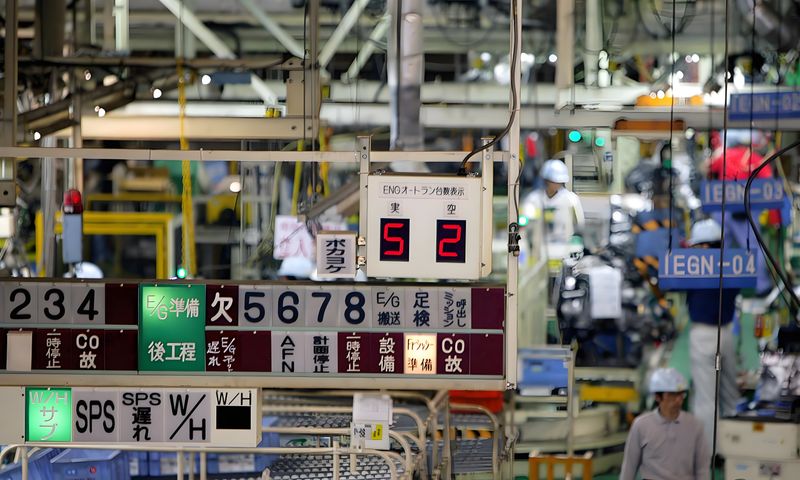
The latest data shows that Japan's exports fell in May for the first time in eight months, raising market concerns about the country's potential entry into a technical recession. With increasing pressure from U.S. tariff policies tightening global trade flows, Japan's export-oriented economy faces renewed challenges.
According to data released by the Japanese Ministry of Finance on Wednesday, May's exports fell by 1.7% year-on-year, better than economists' estimated decline of 3.7%, but still indicating that weak external demand has begun to impact Japan's manufacturing industry. Key sectors experiencing declines included automobiles, steel, and mineral fuels. Meanwhile, imports fell by 7.7% year-on-year, mainly due to reduced purchases of energy commodities like oil and coal.
Falling Exports + Weak Consumption Intensifies Concerns of Technical Recession
This is another key data point showing insufficient economic momentum, following Japan's negative GDP growth at the beginning of the year. If GDP contracts again in the second quarter, Japan will officially enter a technical recession (negative growth for two consecutive quarters).
In addition to export setbacks, domestic consumption has not become an economic pillar. Although inflation remains mild, it continues to outpace wage growth, reducing the real purchasing power of Japanese households and restraining recovery in retail and service consumption.
U.S. Tariff Escalation Pressures Japanese Manufacturing
The biggest uncertainty comes from the U.S. government's series of tariff measures against Japan. President Trump previously announced a 25% tariff on automobiles and auto parts imported from Japan, along with a 10% tariff on all other Japanese goods. In early June, the U.S. also doubled tariffs on steel and aluminum products to 50%.
Despite several rounds of trade negotiations between Japan and the U.S. in recent months, Japanese Prime Minister Shigeru Ishiba failed to reach any new agreements with Trump during the G7 summit this month. According to Japanese sources, the U.S. will cancel Japan's temporary tariff exemptions on July 9, restoring rates to the higher levels announced in early April—24%, further increasing uncertainty about Japan's export outlook.
Global Demand Weakness Pressures Japan's External Dependency
As the world's third-largest economy, Japan is highly reliant on export markets, especially for high-value-added products such as automobiles, semiconductor equipment, and industrial materials. A significant restriction on U.S. exports will directly impact corporate investment and employment expansion expectations.
Meanwhile, the recovery in Chinese and European markets remains weak, unable to effectively compensate for the loss of U.S. exports, leaving Japan facing a more complex external environment.
Policy Outlook: Bank of Japan Faces Dilemma
In the current context of insufficient economic growth momentum, weak inflation, and external shocks, the Bank of Japan may face more policy pressure. On the one hand, Japan has long maintained ultra-low interest rates and yield curve control policies, leaving very limited monetary policy space; on the other hand, fiscal stimulus is constrained by government debt burdens.
Economists expect the government to roll out a new round of fiscal support plans in the second half of the year, focusing on subsidies for small and medium-sized enterprises, energy price stabilization, and household support, to alleviate the dual pressure of weak consumption and shrinking exports.
Japan's Economy Turns Weaker, Trade Environment Becomes a Key Variable
With the May export data turning negative, compounded by pressure from U.S. trade policies, Japan's economic recovery path has become more uncertain. With domestic consumption showing no improvement and external demand facing high tariff barriers, markets will be closely watching whether the Japanese government and the U.S. can reach a new trade compromise before the critical point in July. Otherwise, Japan's economy may face deeper structural challenges in the second half of 2024.