• Home
  • Categories
  • News
  • Community
EN
EN
Home
CategoriesNewsGlossaryCommunityAbout Us
Contact Us
Social Media
Region
🌏International
Region
🌏International

Copyright © 2023-2026 Traderknows Ltd. All rights reserved.

Contact
Home
/
News
/
South Korea's economy shrank in Q1, impacted by tariffs and political instability.

South Korea's economy shrank in Q1, impacted by tariffs and political instability.

TraderKnowsTraderKnows
2025-04-24
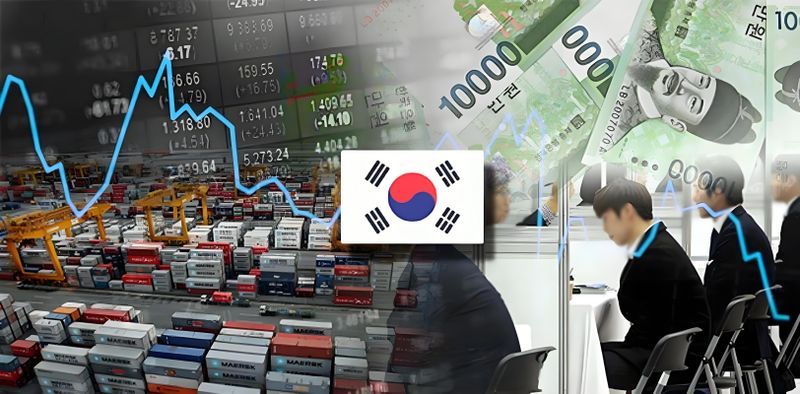
Summary:South Korea's GDP shrank by 0.1% year-on-year in the first quarter of 2025, marking the first economic contraction since the fourth quarter of 2020. Tariffs and domestic political instability were cited as contributing factors.

2025.4.24 South Korea

According to preliminary data, South Korea's GDP contracted by 0.1% year-on-year in the first quarter of 2025, significantly falling short of analysts' expectations for a 0.1% year-on-year growth. This marks the first contraction in South Korea's economy since the fourth quarter of 2020, reflecting the severe impact of domestic political turmoil and unstable foreign trade on the economy.

The South Korean economy had shown a growth trend since the fourth quarter of 2024, with a year-on-year growth of 1.2% at that time. However, the contraction in the first quarter of 2025 indicates a reversal in economic momentum, primarily dragged down by external tariff policies and an unstable domestic political environment. South Korea's economic model heavily relies on exports, particularly steel and automobile exports to the United States. Despite U.S. President Trump's announcement on April 9 to pause the full-scale "reciprocal tariffs," South Korean steel and automobile exports still face a 25% tariff, which undoubtedly has had a significant impact on South Korea's economy.

Steel and automobiles are two of South Korea's main export products to the United States, with Hyundai and Kia cars having substantial sales in the U.S. market, while South Korea is the fourth-largest steel exporter to the U.S. Despite the overall economic slowdown, data indicates that South Korea's exports in the first quarter fell by 1.1% quarter-on-quarter, and it is expected that export drag on the economy will intensify in the second quarter.

In addition to trade uncertainties, the South Korean economy has also been affected by domestic political turmoil. In March 2025, the Constitutional Court of South Korea dismissed the impeachment case against Acting President Han Duck-soo, reinstating him to office, but in April, Yoon Seok-youl was removed from office due to the martial law order incident, causing market concerns about political instability in South Korea. This political uncertainty has exerted pressure on domestic investment, with data showing that in the first quarter, construction investment declined by 3.2% from the previous quarter, and capital investment decreased by 2.1% quarter-on-quarter.

In its monetary policy statement on April 17, the Bank of Korea has already warned that South Korea's GDP growth rate in 2025 is expected to be lower than the previously forecasted 1.5%. Due to continued political uncertainty and deteriorating trade conditions, both domestic demand and exports in South Korea are showing weak performance, with economic growth significantly below expectations. With the upcoming presidential election, South Korea's economic outlook remains fraught with uncertainties.


Business Cooperation Skype ENG

Business Cooperation Telegram Eng

Risk Warning and Disclaimer

The market carries risks, and investment should be cautious. This article does not constitute personal investment advice and has not taken into account individual users' specific investment goals, financial situations, or needs. Users should consider whether any opinions, viewpoints, or conclusions in this article are suitable for their particular circumstances. Investing based on this is at one's own responsibility.

The End
Previous
Next
Comments
0/1000
TraderKnows
Written byTraderKnows
Created date:2025-04-24 02:19
Last Updated:2025-04-24 05:50
Independent Analysis: Manually researched and fact-checked by the TraderKnows Compliance Team, based on public regulatory records.
Wiki
Tariff

Tariffs are a type of tax that governments levy on imported and exported goods, typically appearing as a percentage of the value of the goods.

Organization

Active

TraderKnowsTraderKnows
Recent Post

Trump Invokes Defense Production Act with 850 Million USD for Coal Power to Meet AI Demand

06-05

NY Fed Index Shows High Supply Chain Pressures as Geopolitical Conflicts Raise Global Inflation Con…

06-05

Japan's Real Wages Rise for Fourth Consecutive Month, Fueling June BOJ Rate Hike Bets

06-05

China Flexible Employment Exceeds 300 Million as Blue-Collar Wage Growth Outpaces White-Collar for…

06-05

South Korean Stocks Post Steepest Weekly Drop Since March as Tech Valuations Reset

06-05

China Commercial Paper Rates Drop in Early June Amid Rising Bank Demand

06-05

UK House Prices Unexpectedly Fall in May as Geopolitical Tensions Push Up Borrowing Costs

06-05

Massive Intervention Fails to Save Yen as Short Positions Surge Near Historic Lows

06-05

AI Momentum Pauses as Broadcom Outlook Misses High Expectations; Markets Await Payrolls

06-05

SpaceX Launches 75B USD IPO Roadshow as Access Blocked in Mainland China and Hong Kong

06-05

Global Gold ETFs See $2 Billion Outflows in May as Capital Pivots to Tech Assets

06-05

Nikkei Drops Over 1% on Tech Sector Pullback While Real Wage Growth Provides Support

06-05

South Korea Lifts Mandatory Reporting for Crypto Transfers Over 10M Won

06-05

Amundi Says Asian AI Stocks Supported by Fundamentals as Fed Path Poses Key Risk

06-05

Taiwan Stocks Close 1.33% Lower on Broadcom Drop But Hold Key Technical Support

06-05

Risk Warning

TraderKnows is a financial media platform, with information displayed coming from public networks or uploaded by users. TraderKnows does not endorse any trading platform or variety. We bear no responsibility for any trading disputes or losses arising from the use of this information. Please be aware that displayed information may be delayed, and users should independently verify it to ensure its accuracy.