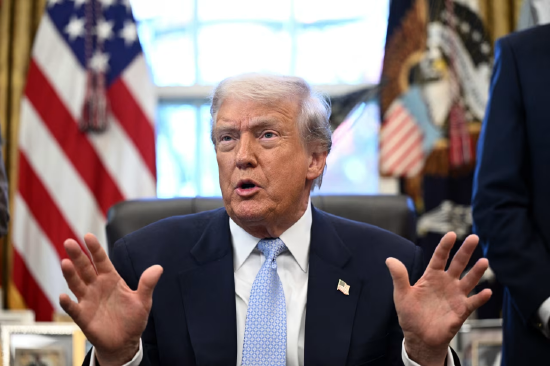
Trump Calls for Expansion of Skilled Immigration to Support Manufacturing Layout
At an economic and investment forum in Washington, former US President Trump reiterated that if the US wants to remain competitive in advanced manufacturing, it must allow more skilled professionals to enter the country. He pointed out that building large technology manufacturing bases requires a large number of skilled workers, and relying solely on local talent cannot meet the operational needs of enterprises.
Trump specifically mentioned the large-scale chip facility under construction in Arizona, stating that such projects not only require capital investment but also rely heavily on technical support from professional teams. He believes that introducing foreign engineers and technicians in the early stages will help the US build a sustainable industrial chain capability.
Acknowledging Stances or Challenging Conservatives, Party Divisions Resurface
Although Trump has historically maintained a tough stance on immigration policies, his support for skilled immigration on this occasion touches on sensitive points among some grassroots conservatives. The MAGA camp has consistently called for stricter border controls and immigration restrictions, viewing Trump's new stance as deviating from his traditional position.
Trump admitted in his speech that he understands this policy might not be welcomed by all his supporters, but he emphasized that if the US wants to develop advanced manufacturing, it must realistically face the labor gap. He even mentioned that his poll numbers might be affected, but believes he can gain industry and skilled workforce support.
Analysts point out that this statement reflects Trump's attempt to find a new balance between economic development demands and his political base, especially as the US manufacturing reshoring policy continues to advance, increasing firms' reliance on skilled talent.
Related Events Highlight Policy Conflicts Between Enforcement and Talent Attraction
Recently, US law enforcement agencies conducted a surprise inspection at a multinational company's factory in Georgia, sparking discussions on the execution scale of US immigration policies. Critics argue that if enforcement actions conflict with policy goals of attracting foreign investment and skilled teams, it could place foreign enterprises investing in the US in an awkward position.
Several analysts note that the US often faces difficulties in the early stages of lacking mature local workers when advancing strategic industrial projects like chips, clean energy, and batteries. Until business training systems are fully established, bringing in experienced overseas personnel is viewed as the most effective short-term transitional solution.
Trump also mentioned in his speech that the purpose of introducing foreign skilled workers is not only to meet project demands but also to hope they can teach critical skills to the American workforce, thereby cultivating a new generation of local engineers.
Advanced Manufacturing Drives Labor Structure Adjustments, Policy Directions Closely Watched
As the US advances large industrial projects, including chip manufacturing, electric vehicle batteries, and high-end manufacturing bases, the labor market is undergoing structural changes. Experts believe that if the US wants to truly rebuild its manufacturing advantage, it must rely on the long-term construction of a talent system, in which skilled immigration plays an indispensable role.
Trump described skilled immigration as a "necessary strategy" and emphasized its core aim of helping the US form a complete technological ecosystem, rather than just temporarily filling personnel gaps.
Future Policy Directions May Affect US Enterprises and Foreign Investment Layouts
As the 2025 policy discussions heat up, Trump's latest statement on skilled immigration may influence corporate investment decisions. The manufacturing sector generally hopes policies can find a balance between strict enforcement and talent mobility, ensuring large investment projects are not hindered.
Regardless of how political controversies unfold, the issue of skilled immigration has become one of the most critical and contentious parts of the US manufacturing reshoring strategy. Trump's latest remarks indicate that this direction will continue to be a focal point for future policy and industry attention.