

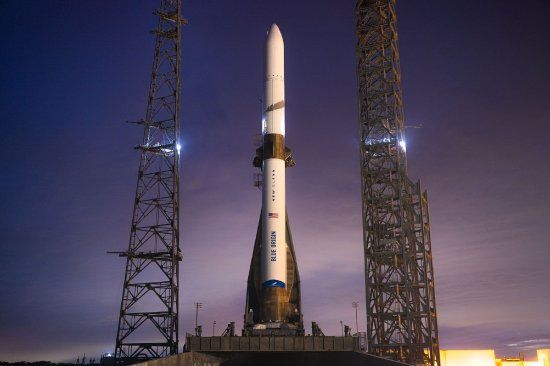
Blue Origin Delays NASA Mission Launch
Blue Origin, the space exploration company owned by Jeff Bezos, has once again postponed the launch of its "New Glenn" heavy-lift rocket. Initially scheduled for Cape Canaveral, Florida, this launch marks New Glenn’s first NASA mission and is seen as a key step for the company in challenging SpaceX.
Blue Origin stated that the launch has been delayed due to "deteriorating weather conditions and technical anomalies with ground equipment." Although no new launch window has been announced, the company has indicated it will "reevaluate and determine follow-up plans," with the timing still uncertain.
First NASA Mission Setback, Mars Project Delayed
The New Glenn mission was originally set to carry two probes manufactured by Rocket Lab to Mars orbit for NASA. This is Blue Origin’s second mission since completing its maiden test flight in early 2025, as well as the rocket's first commercial and research combined mission.
Analysts note that this delay not only suggests a possible rescheduling of NASA's Mars exploration plan but also adds pressure to Blue Origin in its competition for government projects. NASA has previously outsourced some smaller missions to commercial space companies, and Blue Origin hopes to use this opportunity to demonstrate its orbital launch reliability.
Policy Restrictions and Technical Challenges
Besides technical issues, the recent U.S. government shutdown has also disrupted Blue Origin's progress. The Federal Aviation Administration (FAA), facing staffing shortages and budget constraints, issued a temporary order last week suspending some commercial space launch licenses. This order impacted New Glenn's planned backup launch window, meaning that even if Blue Origin completes technical preparations, it cannot immediately receive flight authorization.
Laura Maginnis, Blue Origin's Vice President of Missions, stated at a press conference that the company is working "closely with the FAA and NASA" to assess the possibility of obtaining specific mission exemptions. She emphasized, "Our priority is to ensure safety and compliance; any technical and policy risks must be thoroughly assessed before execution."
Bezos’ Space Ambitions Face Another Test
"New Glenn" is Blue Origin’s flagship rocket project, featuring a reusable first stage design, and holds high expectations for competing with SpaceX’s "Falcon 9." However, since its inception, its development has faced multiple delays. Originally planned for a 2020 launch, tests and supply chain issues postponed it until late 2024, with its maiden flight finally occurring in early 2025.
Dave Limp, Blue Origin's CEO, has stated the company plans to complete 6 to 8 launch missions in 2025, including commercial satellite deployments and research payload transportation. Industry insiders believe that if the second launch continues to be delayed, it will affect the company's contract schedules with clients and weaken its market credibility.
SpaceX Dominates as Industry Competition Intensifies
Currently, Elon Musk's SpaceX maintains a dominant position in the global rocket launch sector. Its "Falcon 9" has achieved over 200 successful launches and is advancing deep-space exploration with the "Starship" project. In contrast, Blue Origin is still in the early stages of commercialization with an evidently lagging client base and launch frequency.
However, space analysts point out that Blue Origin has potential advantages in reusable rocket design, hydrogen-oxygen fuel technology, and low-Earth orbit deployment. Once New Glenn can execute missions reliably, it may have the ability to surpass in cost control and payload capacity.
Outlook: Launch Plans Could Resume in 2025
Although the launch delay has raised concerns, industry experts generally do not think it will alter Blue Origin’s long-term developmental strategy. The company continues to actively expand its technical team and maintains collaboration with NASA on Mars and lunar missions.
If the FAA reinstates commercial space licensing, Blue Origin may attempt the second flight of "New Glenn" in the first half of 2025. This move is not only a crucial technical validation but will also determine whether Bezos can secure his footing in the highly competitive space commerce arena.
For this company, which is entrusted with the mission to "reshape the space transportation landscape," each launch delay is both a risk and a practical test.

