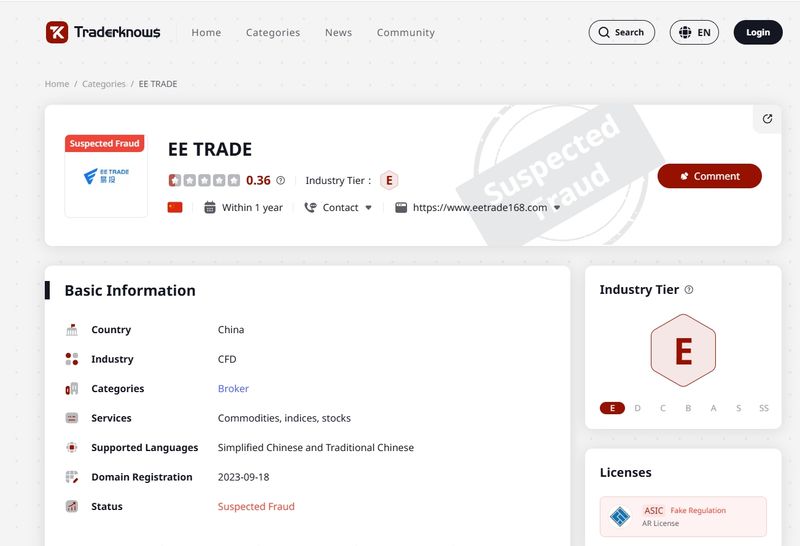
EE TRADE (also known as: Yitou) presents itself as an "international online financial technology company," claiming to offer CFD trading services in forex, precious metals, crude oil, indices, and stocks. The organization behind this is often under EET Markets Global Limited, registered in Saint Lucia. The official website is filled with phrases like "global leader," "authoritative regulation," and "professional risk control," making it appear as a legitimate and reliable platform.
The issue arises as you delve deeper into domain information, regulatory licenses, company background, and actual user feedback, uncovering more suspicions about EE TRADE: the authenticity of its regulation, the legitimacy of its licenses, the actual destination of funds, and whether withdrawals can be successfully retrieved, all fail close scrutiny.
This article focuses on EE TRADE, thoroughly deconstructing its "safety illusion" crafted under regulatory licenses. By combining information from their website, third-party inquiries, and existing complaints, it aims to reveal the truth about regulation, fund safety, and platform logic, warning current or prospective investors about this potentially scam platform.
Let's begin with the regulatory story of EE TRADE
Key points:
- EE TRADE (also known as EET Markets) claims to have Australian ASIC regulation and showcases various "license combos" like Saint Lucia, Canada MSB, and US NFA across different sites;
- However, public records show that it only holds an authorized representative (AR) license under another AFSL holder, rather than its own direct ASIC regulated license;
- Coupled with multiple domains, multiple websites, inflated packaging, and existing withdrawal complaints, the platform is labeled as "suspected scam" and "high risk" by many third parties.
You can understand EE TRADE's regulation story as using a legitimate-looking but marginal "AR license" to create an illusion of safety that makes novices think "one of the biggest global regulators is overseeing my money."
Brand new facade: domain, traffic, and "global leadership" don't add up
Let's start with the most basic thing: how long has this company been operating?
According to whois information, the EE TRADE website domain eetrade168.com was registered on September 18, 2023, and the site started its actual operations around late August 2024. TraderKnows shows it's a newly established site, not what you’d call "long-standing."
Traffic-wise, using tools like SEMrush, the domain's Authority Score is only 2, capturing a mere 2 organic keywords, having neither significant organic traffic nor visible large-scale paid advertising.
Meanwhile, the official narrative on the website is full of bold claims like "global leader," "deep cooperation with top global banks," and "preferred platform for global investors." The stark contrast of a new domain, low traffic, and heavy packaging is common in the forex industry, often indicating marketing claims outpace the actual business scale.
Here’s the key: Does an AR license count as regulation?
One of EE TRADE's favorite talking points is "Australia's ASIC regulation," "AFSL license," and "authorized representative." These sound professional, making ordinary investors feel secure. However, there are key details that need to be clarified.
1. What is an AR? Simply put, it’s a "borrowed identity"
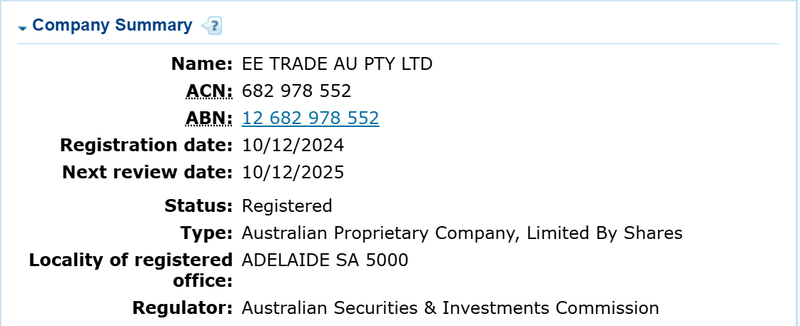
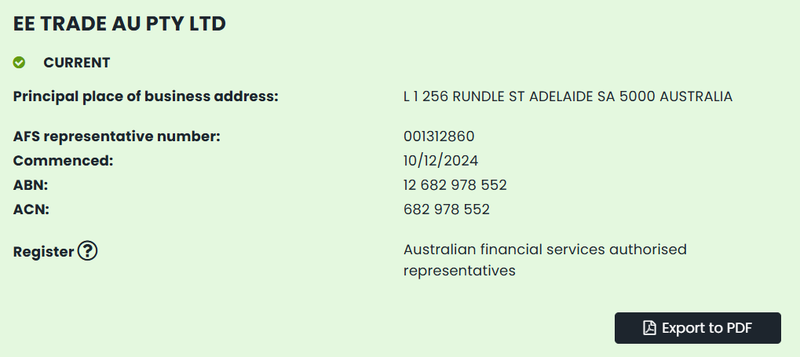
According to public information, EET Markets Global Limited is not the AFSL license holder; it is merely an Authorized Representative (AR) under an Australian license holder.
In layman's terms:
- The actual AFSL holder is the "primary company";
- EE TRADE, as an AR, operates under the primary company’s name to conduct business externally;
- ASIC focuses its regulatory oversight on the primary company, often relying on it for managing multiple ARs.
Research shows the primary company providing the license to EE TRADE (e.g., Opheleo Holdings Pty Ltd) is only permitted to offer "investment advice to wholesale clients," without the authority to engage in forex brokerage for retail customers. Yet, look at what EE TRADE is doing — offering high-leverage CFD trading and a full suite of services in forex, indices, crude, and gold, akin to "using an unsuitable license to operate beyond approved activities."
2. Why is the AR model prone to becoming a "license rental business"?
In the Australian market, an increasing number of AFSL holders are engaging in "license leasing":
- The primary company runs a modest business but charges ARs management fees;
- Performs only formalistic checks on AR's operations, risk control, and fund flows;
- If an AR faces issues, the primary company might only "cooperate with investigations," leaving investors to bear the actual losses.
While ARs technically appear in ASIC’s system, from a regular investor's view, your money might only be dealing with a "borrowed shell company."
3. How does the website "tell a story"?
Even more concerning is how EE TRADE tells its story:
- Using grand terms like "Australian ASIC authoritative supervision" in promotions;
- Rarely highlighting "we are just an AR of an AFSL license holder, serving only wholesale clients";
- Coupled with phrases like "funds are in independent accounts at top banks like Citibank, HSBC, JPMorgan," to craft a sense of "regulated and bank-backed security."
For retail investors unfamiliar with the regulatory system, this packaging is easily misinterpreted as:
"ASIC has thoroughly inspected this platform, everything is compliant, and my money is protected by Australian regulation."
The truth is:
You see an "AR license with a pretty story," but not the primary company's actual business scope, regulatory boundary, and whether this company can abruptly treat you as a "sacrificial front-end shell."
Four, multiple websites, multiple regulations, numerous disguises: a typical high-risk combination
Continuing the investigation, you’ll find EE TRADE doesn’t only have one website:
- eetrade168.com: Claiming to be Yitou EE TRADE, a global leading CFD platform;
- eetrade.com: Also under the EE TRADE Yitou brand, promoting smart trading, AI strategies, gold, and silver;
- eetrade888.com, eetradehk.com sites, operating under the "Yitou EET Markets" name, highlighting Saint Lucia IFC regulation, registration number 2024-00650, and a Hong Kong phone number +852 9468 7235.
Different sites alternate between featuring Saint Lucia, ASIC, Canada MSB, and US NFA, compiling a "qualifications collage" from various regulatory symbols.
Third-party evaluations have pointed out:
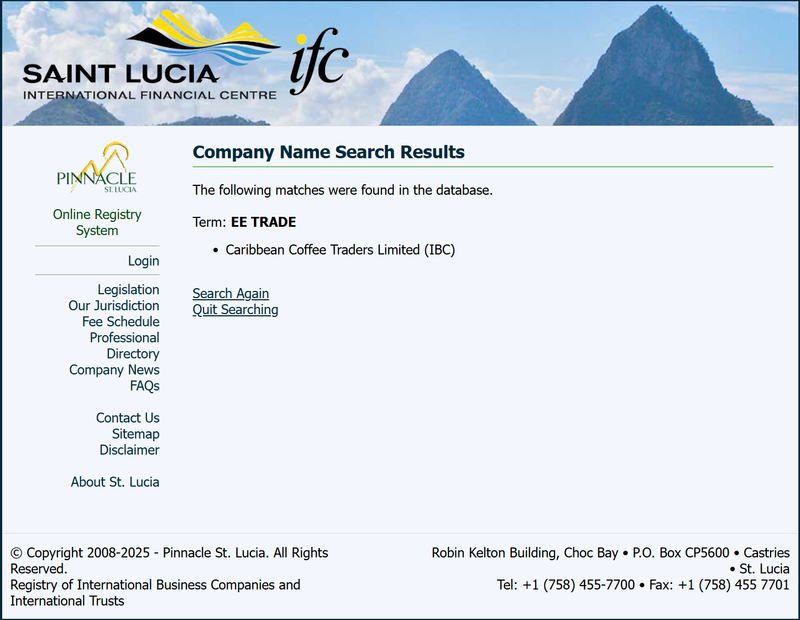
- The so-called "regulation" of Saint Lucia is mainly just an offshore company registry and doesn’t substantively regulate forex CFD businesses;
- Some regulatory numbers don't match publicly available information, hinting at "license cloning" or "fraudulent regulation";
- There is a significant disconnect between the primary company and EE TRADE's actual operations entity.
For an ordinary investor, a simple intuitive approach is:
A genuinely compliant big platform will clearly disclose a uniform entity name, license number, and regulator on one main website;
Conversely, if you find a brand with a heap of domains, a bunch of different company names, and different versions of "regulatory stories," it’s usually time to leave instead of trust it.
Actual user experiences: inability to withdraw funds, money being transferred to personal accounts
If license stories are "professional-level" issues, then existing user complaints are the most direct alarms.
On exposure platforms, investors have detailed their experiences with EE TRADE:
- Initially funded trading through an app called "Anxin," later the platform forced an upgrade and the app was directly replaced by "EE TRADE";
- Customer service continuously bombarded them with phone calls, under the guise of "giving away packages, bonuses" to induce frequent funding and high-frequency trading;
- Facing serious platform lags and slippage during trading, and frequent issues with recharge channels when margin was insufficient, leading to forced liquidations;
- Later investigation revealed that funding wasn’t deposited into a regulated brokerage trust account but transferred to personal accounts, making it entirely opaque whether funds truly entered the market;
- When proposing to defend rights and question the platform, it’s alleged to engage in illegal operations, suspected money laundering, and manipulative marketing. WikiFX
These accusations are primarily found in third-party exposures and narratives from parties involved, with final determinations left to regulators and judicial authorities. But from a regular investor's perspective, you must ask yourself:
Faced with a platform with questionable licenses, confusing stories, and existing complaints of withdrawal issues, do you still need to risk your savings to "validate its authenticity"?
Six, don’t let "complete features" and "education areas" numb your vigilance
Fairly speaking, EE TRADE has indeed put effort into its website:
- Designed various account tiers like Mini/Standard/VIP with various upgrade criteria, rebates, red packets, and interest returns, appearing "well thought out";
- Established newcomer areas and video tutorials explaining CFDs and order placements, leaving novices with a sense of "guided learning";
- Pages load quickly, navigation is clear, and registration forms are neatly designed.
At first glance, these look "impressive." But the issue is:
- No matter how well-designed a page is, it can’t hide multiple disguises and unclear regulation;
- No amount of video tutorials can replace genuine, effective regulatory protection;
- Even the most customer-friendly service, if backed by a platform that might refuse withdrawals at any time, is just a "sugar-coated trap.".
Many who have fallen into such traps later reflect:
“I felt the website was too professional and lowered my guard.”
If you are already confused by AR licenses, follow these steps for self-check
Not only for EE TRADE, but any forex/CFD platform under the "AR" or "Authorized Representative" banner can be verified like this:
- First, check the license on ASIC's website:
- Search the AFSL number or primary company name to identify the license holder;
- Check whether the license permits serving "wholesale" or "retail" clients;
- Review the business scope description, whether it involves investment consulting, fund management, or retail OTC derivatives brokerage.
- Search the AFSL number or primary company name to identify the license holder;
- Then verify the AR identity:
- ASIC's system usually lists authorized representatives;
- Compare the AR’s name with the platform brand you are using;
- Check the authorization time, status, and any suspension/termination records.
- ASIC's system usually lists authorized representatives;
- Verify company registration information:
- For example, EE TRADE claims to be registered in Saint Lucia; you can input the company number into the local IFC system to verify name consistency;
- If the registered entity’s main business significantly deviates from forex (such as a "computer services company" fronting forex operations), be wary of "shell company with guises.".
- For example, EE TRADE claims to be registered in Saint Lucia; you can input the company number into the local IFC system to verify name consistency;
- Check domains and site networks:
- Use whois to check domain registration time, and holder;
- See if multiple highly similar sites share the same stories and customer support contacts.
- Use whois to check domain registration time, and holder;
- Search for complaints and exposures:
- In various review sites or forums, search for EE TRADE or EET Markets Global Limited;
- Pay special attention to keywords such as “unable to withdraw funds,” “forced liquidation,” “induced deposits,” or “funds transferred to personal accounts.”.
- In various review sites or forums, search for EE TRADE or EET Markets Global Limited;
By completing these steps, you will likely discern whether a platform is a "serious financial institution" or a "high-risk scheme masked by a regulatory cover."
In Conclusion
Based on the information above, our judgment on EE TRADE/EET Markets Global Limited is straightforward:
- Operating under an AR license, qualifications of the primary and actual business misaligned;
- Multiple websites, conflicting stories, and inconsistent regulation narratives;
- Detailed real account victim complaints exist, involving inducement to deposit, inability to withdraw, and funds going to personal accounts;
- Combined with its very short operational history and weak real online influence, these factors make it challenging to regard it as a legitimate platform worthy of accommodating your funds.
For regular investors, there are well-regulated, historically stable, and transparent established brokers in the market. There is no need to entrust your hard-earned money to a high-risk platform built on an AR license and marketing scripts.
If you already have funds in EE TRADE, we recommend immediately assessing the risk and withdrawing if it can be done safely; if you were just introduced to this name by ads, customer service, or acquaintances, the best decision is to keep it at “heard of, but never boarded.”