

Background of Oakstone Society Platform
Public information reveals that Oakstone Society positions itself as a platform combining financial research, artificial intelligence technology, and investment education. The main content of the platform includes quantitative research, investment courses, and market analysis.
In its introduction, Oakstone Society emphasizes assisting investment decisions through artificial intelligence and data models while providing research and educational resources across markets for students and users. Its curriculum system typically starts with basic finance knowledge and gradually extends to risk management, quantitative methods, and cross-asset investment strategies. The course content covers multiple financial markets, including the stock market, bond market, foreign exchange market, commodities market, and digital asset field. The platform also states that its course cases will incorporate the financial market environments of different regions to help learners understand the workings of the global financial system.
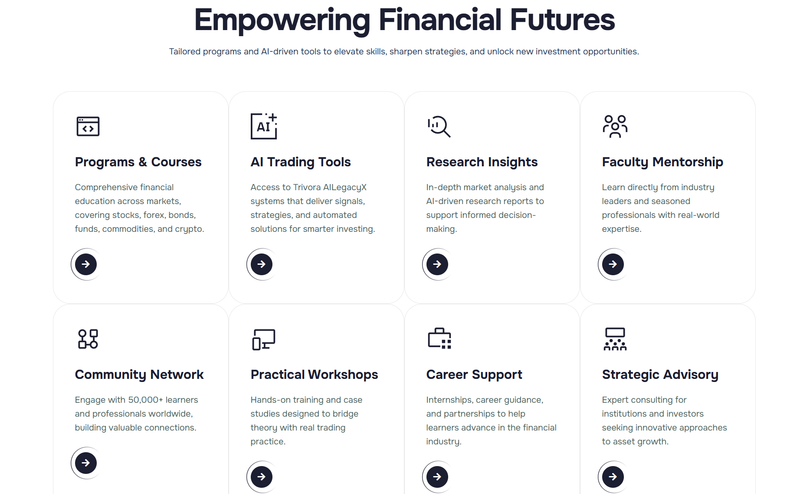
Trivora AI System and Product Structure
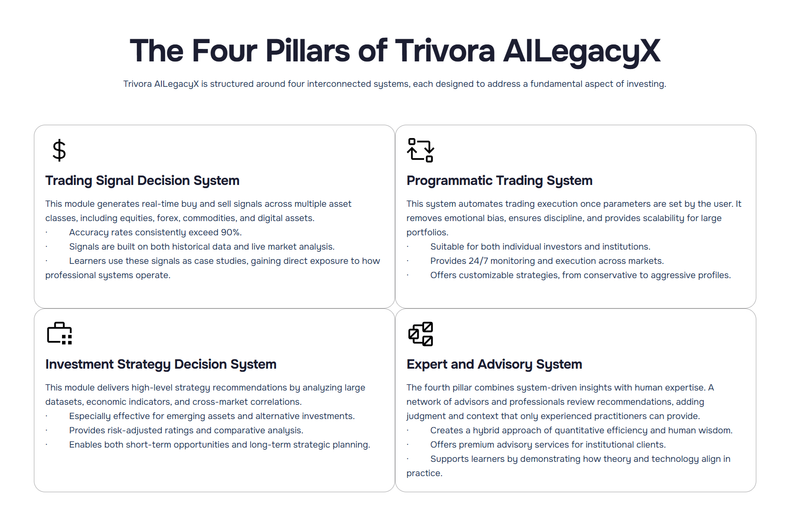
The core product presented by Oakstone Society is Trivora AI (Trivora AILegacyX). According to the platform's introduction, this system is composed of multiple modules to support investment decision-making and trade execution.
Trade Signal Decision-Making System
This module generates real-time trading signals, covering multiple asset classes including stocks, forex, commodities, and digital assets.
The system analyzes historical data and real-time market information to generate buy and sell signals. According to the platform, these signals can be used as trade references or case studies to help users understand the workings of quantitative trading systems.
Automated Trading System
The automated trading module allows users to automatically execute trading strategies after setting parameters. The design goals of the system include reducing emotional interference, improving trading discipline, and supporting large-scale portfolio management.
The platform states this system can achieve:
- 24-hour market monitoring and execution
- Multi-market trading support
- Customizable trading strategies
Investment Strategy Decision-Making System
This system is primarily used to analyze macroeconomic indicators, market data, and cross-market correlations to provide strategic references for investors.
The analysis content includes:
- Risk-adjusted return assessment
- Asset allocation suggestions
- Short-term market opportunity identification
- Long-term investment strategy planning
Expert and Consultancy System
The Trivora AI system also includes an expert consultation module. This module combines algorithm analysis with expert assessment, providing supplemental explanations for some investment recommendations through a consultant network.
The platform states this model aims to combine quantitative models and industry experience to offer more comprehensive investment analyses.
Research Fields and Technological Directions
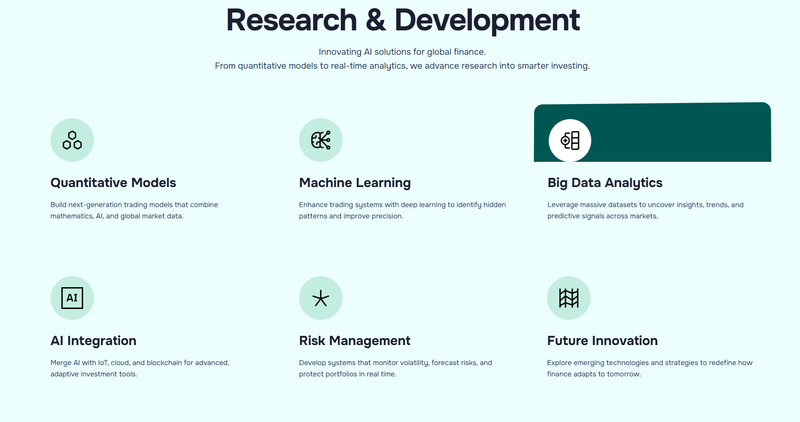
Regarding research and technology development, Oakstone Society states its primary focus on the following areas:
Quantitative Finance
The team constructs quantitative models to analyze historical and real-time market data to identify potential trading opportunities and assess asset risks.
Cross-Asset Investment Strategies
The platform studies the relationships between stocks, bonds, forex, commodities, and alternative investments and attempts to enhance portfolio stability through combination allocation.
Risk Management and Portfolio Analysis
Research focuses include portfolio stress testing, volatility analysis, and risk exposure management to assist investors in asset allocation in uncertain market environments.
Emerging Investment Fields
The platform also mentions its research scope covers digital assets, sustainable finance, and other emerging investment fields, showcased through research reports and course content.
Media Information and Educational Content
In addition to technical systems, the Oakstone Society website also provides a range of market news and research articles.
These contents usually focus on macroeconomic and financial markets, such as:
- Federal Reserve interest rate policy analysis
- Macroeconomic trend reviews
- MicroStrategy Bitcoin holdings analysis
In the education system, platform courses start from basic financial knowledge and gradually expand to more complex investment strategies and market analysis methods. The course content emphasizes the combination of theory and practice to help learners understand the operational logic of financial markets.

Domain Information and Website Operation Time
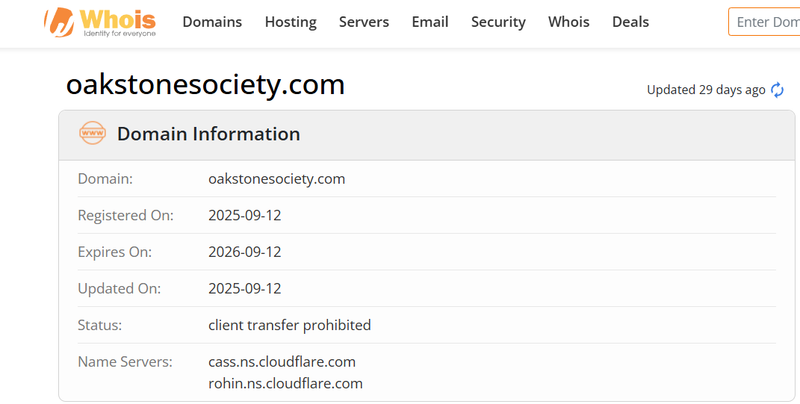
According to publicly available WHOIS information, the official website oakstonesociety.com of Oakstone Society was registered on September 12, 2025, with the latest update also on September 12, 2025.
Domain registration time can reflect the activation time of a website, but it usually does not directly indicate the platform's business history or operation time.
Additionally, multiple websites related to the brand appear in public information, such as:
- eramixfinancial-union.review
- eramixfinancial-union.wiki
- eramixfinancial-union.info
Regulatory Information and MSB Filing Explanation
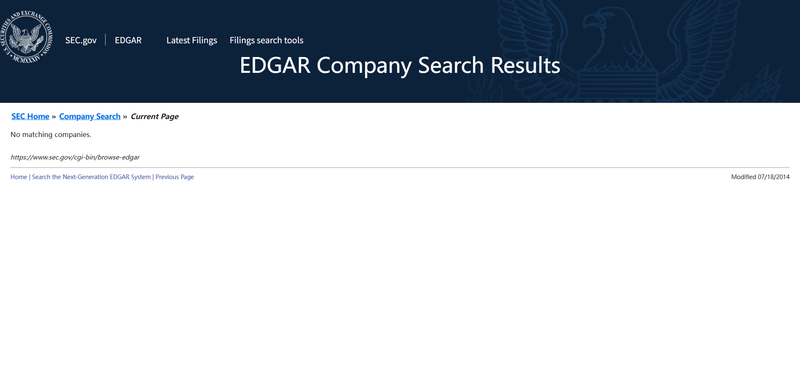
Public data shows that Oakstone Society is not subject to the investment business regulation of the U.S. Securities and Exchange Commission (SEC).
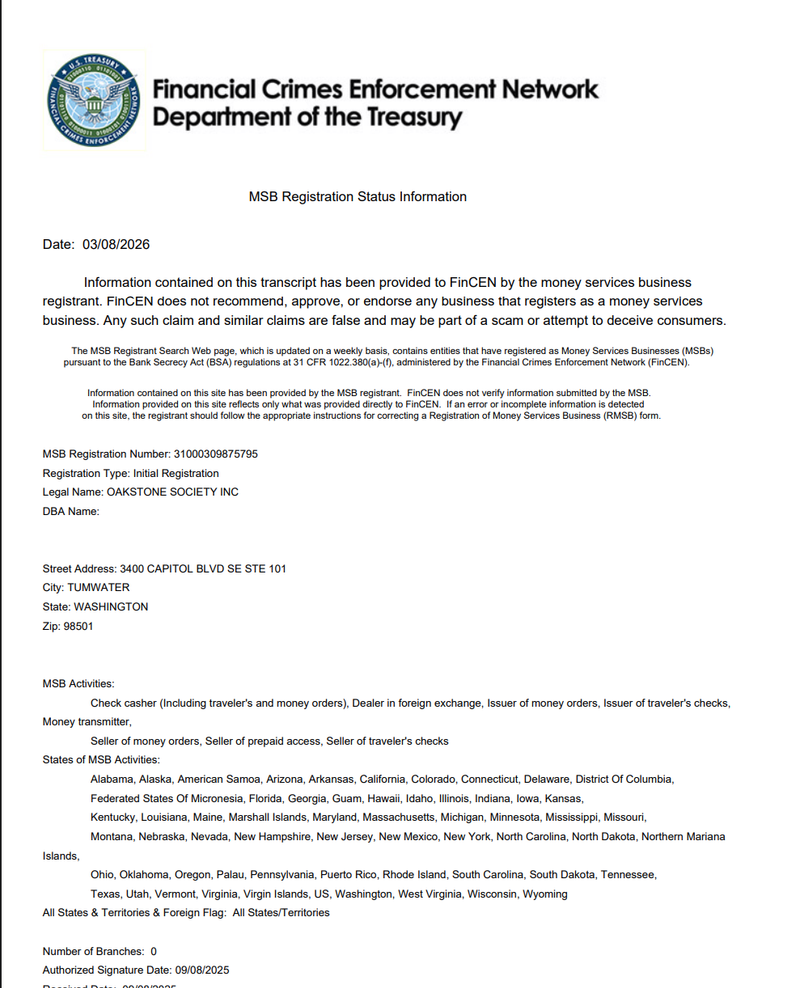
Some information mentions its connection to the Financial Crimes Enforcement Network (FinCEN) for Money Services Business (MSB) registration.
The MSB registration typically applies to the following types of businesses:
- Money transmission services
- Currency exchange
- Issuance of traveler's checks or money orders
- Sales of prepaid cards
FinCEN clarifies on its website that MSB registration does not constitute government approval or endorsement of relevant businesses. FinCEN warns the public that some fraudulent behavior might mislead investors by claiming "MSB approval."
Thus, MSB registration mainly falls under the anti-money laundering regulatory framework and is not equivalent to investment management or securities trading licenses.
Website Traffic and Market Attention
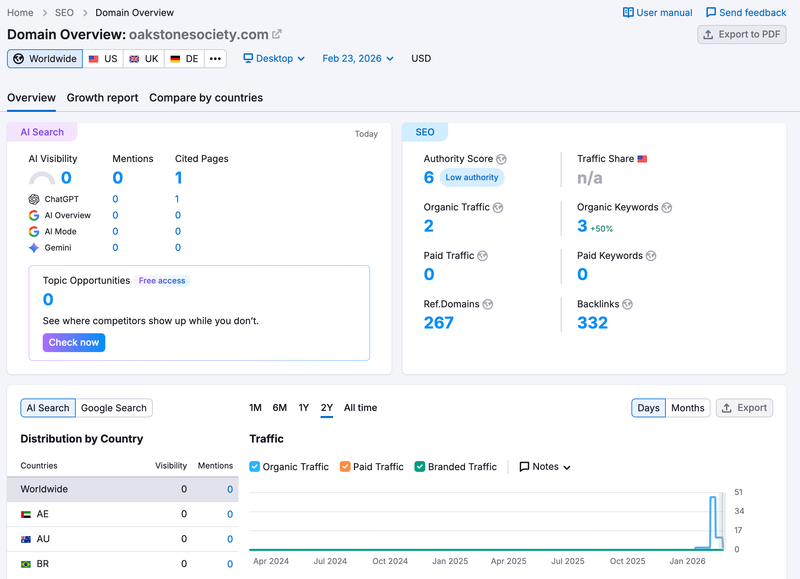
According to statistics from the third-party website Semrush, the overall traffic to the Oakstone Society website is relatively low, with limited monthly visits.
Website traffic data typically reflects a platform's user activity and market attention. In some cases, newly launched sites or small-scale platforms may also have low traffic.
Contact Information and Public Information
Oakstone Society provides the following contact information on the website:
Email
[email protected]
Address
3400 Capitol Blvd Se Ste101, Tumwater, WA, 98501-3351, United
In the publicly available search range, no official Oakstone Society social media accounts have been found yet. For financial service platforms, social media is often an important channel for information dissemination, customer communication, and brand promotion.

Registration Process Evaluation
From the website usage experience, Oakstone Society's page structure is generally clear, and the navigation logic is relatively intuitive. The homepage typically displays information segments on platform introduction, product functions, research content, and course systems, allowing users to quickly find the sections they are interested in when first visiting. This structure is a relatively common design approach for financial platforms, aiming to first convey the platform's positioning, then gradually guide users to understand its products, research, and services.
Further, Oakstone Society's columns are clearly divided into main and subcategories. For instance, the platform presents modules like Trivora AI, course content, research directions, and market news separately, rather than stacking all the information on a single page. This approach helps lower the reading threshold and allows ordinary users to quickly form a preliminary impression of the platform's business framework. For visitors without much financial background, an interface that isn't overly complex with clear entrances is an important positive experience factor.
However, from the perspective of "registration process evaluation," a clear interface does not equal sufficient information. A competent financial service platform, in addition to a neat page and clear columns, should disclose key instructions during the registration or account opening related sections, such as target audiences, business nature, applicable regions, risk warnings, and account opening conditions. If the page focuses more on technological capabilities or course promotions, while lacking a sufficient explanation of post-registration service boundaries, account mechanisms, and user applicability, users might be able to "enter smoothly" but may not clearly understand "what service they are signing up for."
Therefore, Oakstone Society performs reasonably well in interface logic, with no obvious confusion in information layout and column hierarchy. But from a stricter platform evaluation standard, whether the registration process truly possesses the characteristics of being "transparent, complete, and easy to judge" should be judged comprehensively with the account opening page, service agreement, business disclosures, and risk explanations, not just by how easily the page can be found or how clear the buttons are.
Education Resource Assessment
From the public display content, Oakstone Society has indeed devoted a lot of space to educational resources. The platform's content covers basic financial knowledge, investment product recognition, risk management, quantitative methods, cross-asset allocation, and macro analysis, presenting a relatively complete structure. For users new to the financial market, such an arrangement from basics to advanced theoretically helps establish a more systematic learning framework rather than just staying at the level of fragmented information reception.
In terms of content positioning, these teaching materials are more inclined towards "textual knowledge output." The platform uses lengthy explanations to describe market mechanisms, introduce the characteristics of different asset classes, and supplement with some market commentary, research articles, and thematic explanations. The advantage of this expression method is the high information density, suitable for users with a certain reading habit, aiming to systematically acquire knowledge. Especially on conceptual themes like macroeconomics, cross-market analysis, and risk management, textual narration indeed facilitates unfolding logic chains.
But from a learning experience perspective, the current educational resources of Oakstone Society have obvious limitations. One straightforward issue is the single content presentation method, mainly textual explanations, lacking chart dissection, case illustrations, process schematics, or video support. When it comes to financial education, many concepts are inherently abstract, such as asset allocation, volatility management, cross-market linkage, and quantitative strategy frameworks. Without graphical expression, ordinary users may rely more on textual patience and raise the learning threshold accordingly.
Overall, Oakstone Society's educational resources are relatively complete in thematic coverage and possess a degree of systematization; however, they lean more towards traditional textual expression in content form, with limited interactivity and visualization. From the perspective of EEAT's "Expertise" and "Usefulness," these resources can demonstrate the platform's intent to establish a knowledge framework, but whether they are efficient enough or truly suitable for a wider range of ordinary investors also requires a comprehensive judgment based on content update frequency, case authenticity, and expression methods.
Platform Information Disclosure Completeness
Platform information disclosure is a crucial aspect of assessing the credibility of financial websites. For ordinary users, whether a platform is worth further exploration often doesn't depend on how many "technical stories" it tells but whether it clearly explains the most basic and critical background information. For instance, who the company is, where it is, what regulations it is under, the nature of the services it provides, the regions it applies to, and whether there are business restrictions. These are the key points users value when making judgments.
From the current public presentation, Oakstone Society provides extensive introductions on product functions, technical systems, course content, and research directions, but is relatively limited in company-level background disclosure. Although the website provides contact email and address information, it does not form a clear, focused, and verifiable "Company Information Description" module. For users, this means being able to see what the platform "wants to do" but finding it harder to quickly confirm what the platform "actually is."
Another point of concern is that the way regulatory qualifications are presented needs to be sufficiently accurate. For ordinary users, seeing a platform mention some kind of "filing" or "registration" can easily lead to naturally associating it with having been "approved by regulation." But actually, the business scope and legal implications corresponding to different registration systems might be entirely different. If the platform does not use clear and accurate language to explain what these registrations entail and do not entail, then even if information disclosure "mentioned it," it might not be considered "complete and transparent."
Therefore, from the perspective of platform information disclosure completeness, Oakstone Society currently seems more like in a "content presentation is plenty, but subject explanation is limited" state. It is not entirely devoid of public information, but still lacks a sufficiently clear, easily verifiable disclosure framework in terms of company introduction, regulatory attributes, business boundaries, and qualification description. This information asymmetry raises the cost of user judgments and undermines the platform's performance in the EEAT dimension.
Platform Authenticity Self-Check
Entity Information Verification (SEC)
- Visit the relevant search entrance of the U.S. Securities and Exchange Commission (SEC) official website
- Enter the Company Name / Possible ID provided by the platform
- Compare the company name in the query results with the entity claimed by the platform word for word (pay special attention: abbreviation, spacing, group/subsidiary naming differences)
Regulatory Information Verification (FinCEN)
- Visit the relevant search entrance of the Financial Crimes Enforcement Network (FinCEN) official website
- Enter the registration information or name claimed by the platform
- Compare the name in the query results with the platform subject information
Using Whois to Assess Domain Longevity (Repeatable Process)
Domain longevity is often used to help determine a website's "historical continuity." However, it's important to note that early registered domains don't necessarily mean early existing business because domains may be long-ambled, transferred, or repurposed.
Operating steps:
- Visit whois.com
- Enter the broker/platform domain (e.g., nalera.com)
- Check the “Creation Date”
- Calculate the domain registration longevity (current year - registration year)
Signals Users Need to Be Cautious About
In actual use, users can focus on the following types of signals. While these signals may not necessarily indicate a problem on their own, if multiple are present simultaneously, further cautious investigation is warranted.
Firstly, domain registration longevity of less than one year. A new domain doesn't equate to a risky platform, but if a website has just gone online recently yet is already making widespread proclamations in the tone of a mature financial institution, users should be vigilant. This is because financial services inherently need time to build reputation, and overly new online traces often imply limited verifiable history.
Secondly, the running time claimed by a website mismatches with domain longevity. This is a typical self-check focus. If a platform emphasizes "years of experience" and "long-term global market layout" in its introduction, but the Whois query shows the official website registration time is brief, while the platform hasn't explained brand renaming, URL switching, or historical website evolution, then this time gap deserves further verification by users.
Thirdly, lack of transparency on the website. The transparency mentioned here isn't just about "whether there's contact information," but about whether there's a complete, verifiable information chain. This includes whether the company entity is clear, whether the regulatory attributes are explained clearly, whether the business nature is clarified, whether the applicable regions are visible, whether the qualification explanation is verifiable, and whether the historical information is consistent. If a platform has a lot of product publicity but critical background information is scattered or even vague, users will find it hard to make independent judgments.
Summary
Pros
- The product and technological framework is relatively complete
Oakstone Society showcases a relatively systematic technical structure on the website, such as the Trivora AI system, which includes modules like trade signals, automated trading, strategy analysis, and expert consultancy. From the perspective of information structure, its product design logic is relatively complete, forming a framework that revolves around quantitative analysis and investment research. - The research and education content system is relatively systematic
The platform's educational resources cover multiple areas, including basic financial knowledge, risk management, quantitative methods, and cross-asset investment. From the course structure descriptions, its content tries to extend from foundational knowledge to more complex investment strategies, with a clear learning path overall. - Involves multi-market research perspectives
In research content, Oakstone Society involves not only traditional financial markets such as stocks, bonds, and forex but also mentions emerging investment fields such as digital assets. The cross-asset research approach helps users understand the correlations between different markets and the logic behind portfolio construction. - The website structure is relatively clear
From a user experience perspective, the website navigation logic is relatively simple and clear, with each column clearly divided, allowing users to easily find product introductions, research content, and course materials.
Cons
- Limited disclosure of platform entity information
Although the website provides contact email and address information, there is little disclosure of core information such as company background, establishment time, and management team. For financial service platforms, such information is typically a crucial basis for users to judge the platform's reliability. - Regulatory attributes are not clearly explained
The platform mentions information related to FinCEN MSB registration, but MSB registration itself falls under the anti-money laundering framework and is not equivalent to a securities or investment business license. Without clearer regulatory explanations, users might have room for misunderstandings when understanding the platform's regulatory attributes. - Short domain history
Based on public WHOIS data, the Oakstone Society website domain was registered in 2025. A relatively new domain doesn't necessarily indicate an issue with the platform, but the publicly verifiable operational history is relatively limited. - Low website traffic and market activity
Third-party traffic platforms show that overall traffic to this website is low. From the perspective of market attention, the current user scale or market influence of the platform remains limited. - Limited social media channels
In the scope of public searches, no active official social media accounts for Oakstone Society have been found. For financial service platforms, social media is typically an important channel for information disclosure, branding, and user communication.
Overall, Oakstone Society demonstrates a certain structured design approach in its technological system, research direction, and educational content, especially through the product framework built around Trivora AI, reflecting the platform's aim to combine quantitative analysis with investment education. However, in terms of information transparency, regulatory explanations, and publicly verifiable operational history, there are still areas that need further improvement.
For users interested in this platform, understanding its technology and educational content is one aspect. At the same time, independent verification through public information, regulatory databases, and domain records is recommended for a more comprehensive judgment.
Disclaimer: This content is based on public information and platform testing experience; actual effects may vary depending on market conditions.