

Harborstone Society is a platform focused on financial research and education. The website's content primarily revolves around investment methodologies, financial curriculum systems, and research projects. Among them, the Erydon AILegacyX framework proposed by the platform is regarded as its core conceptual structure, used to build systemic financial learning and decision-making models. According to public information, the institution's curriculum covers multiple levels, including basic financial knowledge, investment strategies, and executive education, as well as quantitative finance, risk management, and global markets. This article will analyze the structure, educational system, domain information, and regulatory-related situations of the Harborstone Society website based on publicly available information.
Domain and Website Information
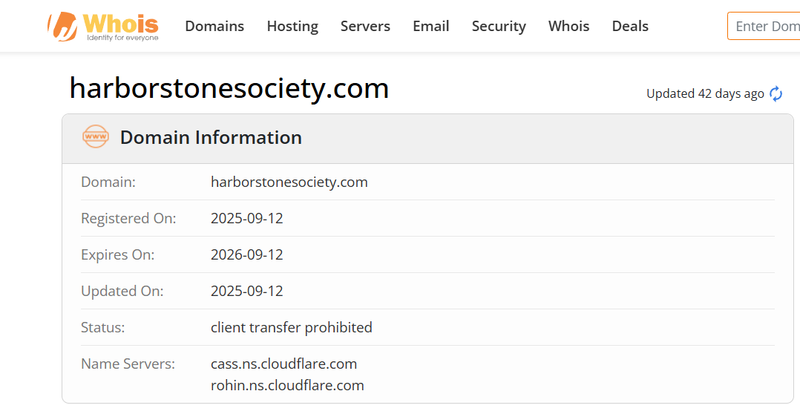
According to WHOIS query records:
- harborstonesociety.com
- Registration Date: 2025-09-12
- Last Updated: 2025-09-12
- Registration Date: 2025-09-12
Moreover, related sites to Harborstone Society include:
- harborstone-society.review
- harborstone-society.info
Public information shows that both domains were registered on 2025-09-11.
Erydon AILegacyX Project Framework
The core system proposed by Harborstone Society is Erydon AILegacyX. This project mainly revolves around financial learning, decision-making frameworks, and investment strategy research.
From its open description, the framework aims to help learners understand financial markets through structured methods and enhance decision-making skills through practice and research.
Core Philosophy and Guiding Principles
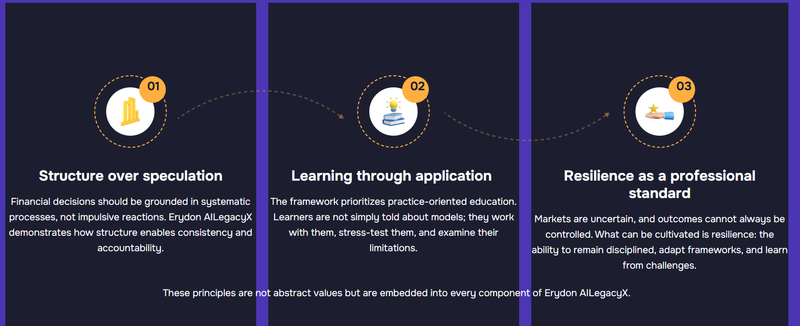
Harborstone Society presents three core philosophies in its project introduction.
Structure over Speculation
This philosophy emphasizes the importance of systematic analysis. The platform advocates understanding markets through logical frameworks and systematic methods rather than relying on short-term speculative behavior.
Learning through Application
This philosophy emphasizes the integration of theory and practice. Learners apply financial theories to specific problems through case studies and real-world scenario analysis.
Resilience as a Professional Standard
This philosophy emphasizes the building of long-term capabilities, including risk awareness, continuous optimization of strategies, and establishing a stable decision-making system.
Erydon AILegacyX Core System Structure
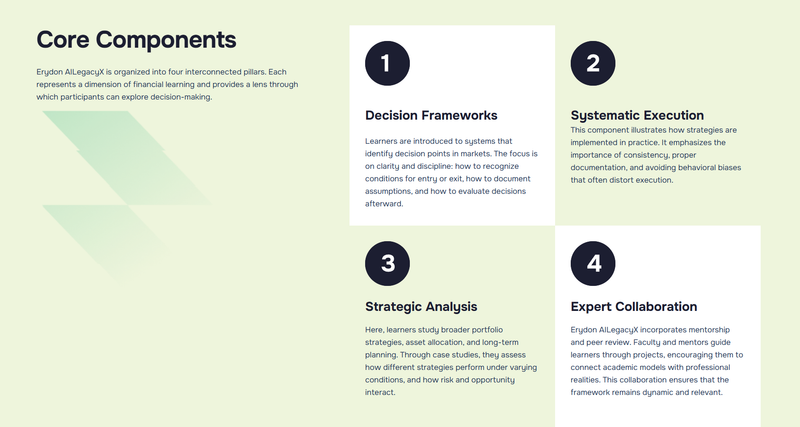
According to the public information of Harborstone Society, Erydon AILegacyX is composed of four main modules.
Decision-Making Framework
This module focuses on the logic of market decision-making. Learners will engage with systems used to identify market decision points, including how to determine entry or exit conditions and how to record hypotheses and conduct subsequent evaluations.
System Execution
The system execution part emphasizes the application of strategies in real environments. The platform stresses the importance of discipline, documentation, and avoiding behavioral biases in this module.
Strategic Analysis
The strategic analysis module primarily involves portfolio construction and long-term planning. Learners analyze the performance of strategies in different market environments through case studies and examine the relationship between risk and opportunity.
Expert Collaboration
The Erydon AILegacyX framework also includes a mentorship and peer evaluation mechanism. Teachers and mentors participate in project guidance, with learners completing research and analysis tasks collaboratively.
Research Areas and Strategic Directions
The research projects of Harborstone Society mainly focus on multiple financial domains.
Key Research Areas
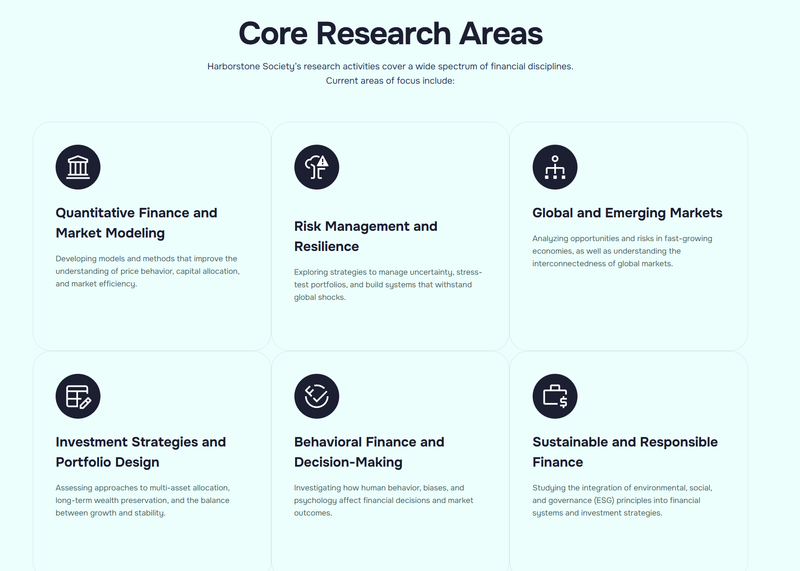
The currently publicized research directions include:
- Quantitative Finance and Market Modeling
- Risk Management and Financial Resilience
- Global and Emerging Markets Research
- Investment Strategies and Asset Allocation
- Behavioral Finance
- Sustainable and Responsible Finance
These research topics involve market models, asset allocation, risk management, and ESG among other areas.
Strategic Research Focus
In terms of research development directions, Harborstone Society has proposed three main goals:
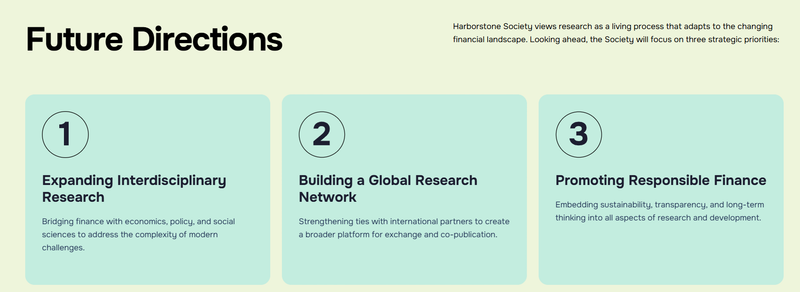
Expand Cross-Disciplinary Research
Research plans attempt to integrate finance with economics, public policy, and social sciences to analyze more complex market environments.
Build a Global Research Network
The project plans to establish a broader research and publication network through international cooperation to promote academic exchange.
Promote Responsible Finance
Research content emphasizes sustainable development, transparency, and the construction of a long-term financial system.
Harborstone Society Curriculum System
The curriculum system of Harborstone Society covers multiple learning stages, from basic financial knowledge to advanced professional training, and executive education at the institutional level.
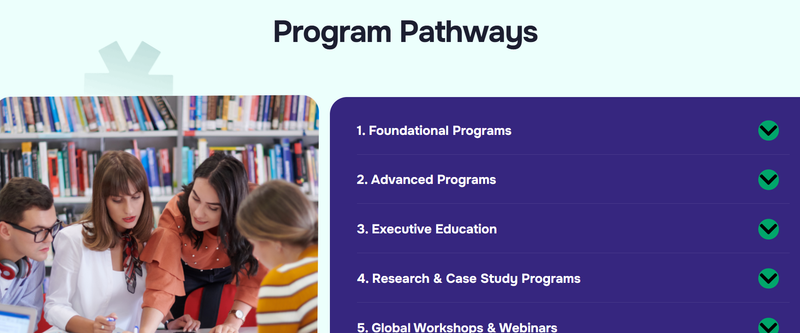
Basic Courses
Basic courses are primarily designed for beginners in the financial field.
Course content includes financial market structures, corporate finance, investment principles, and the fundamentals of risk management. The teaching methods often combine lectures, case studies, and simulations.
The target audience mainly includes undergraduates, newcomers to the financial industry, and individuals looking to transition into finance.
Advanced Courses
Advanced courses focus on deepening professional skills and investment analysis capabilities.
Topics cover portfolio management, quantitative methods, fixed income strategies, derivatives, and multi-asset allocation. The teaching approach often includes case analysis, historical data simulations, and group projects.
The target learning group primarily consists of financial analysts, mid-level professionals, and individuals preparing to enter asset management or investment management sectors.
Executive Education
Harborstone Society also offers executive courses for institutional management.
Course content involves global strategies, risk governance, regulatory frameworks, sustainable finance, and leadership in financial institutions. The teaching format mainly includes seminars, scenario simulations, and executive discussions.
Research and Case Projects
Some courses allow learners to participate in research projects, such as case study development, co-writing research papers, and attending academic seminars.
These projects are primarily aimed at postgraduate students, researchers, and finance professionals looking to enhance their research capabilities.
Global Seminars and Webinars
The platform also offers short-term learning activities, including global seminars and online webinars.
Related topics usually focus on market trends, regulatory policy changes, risk management practices, and global financial case studies.
Faculty and Professional Areas
Harborstone Society lists multiple faculty research directions on its introduction.
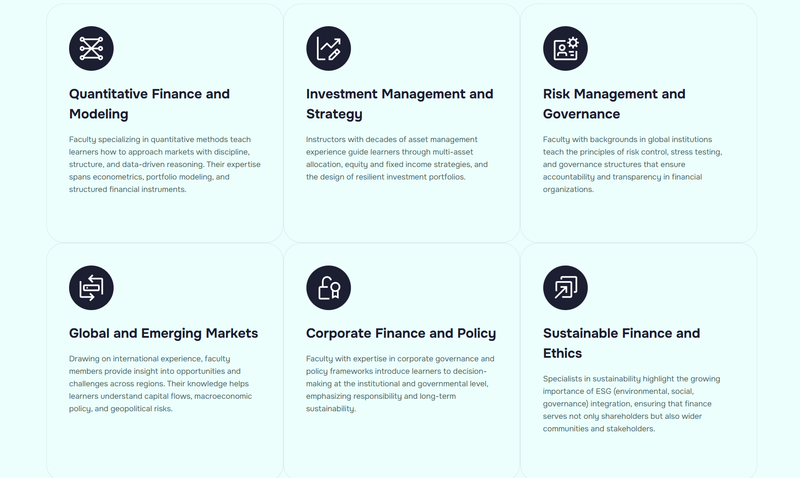
Quantitative Finance and Modeling
The teaching team covers research areas such as econometrics, portfolio modeling, and structured financial instruments.
Investment Management and Strategy
Some instructors have asset management experience, with courses involving equity strategies, fixed income, and multi-asset allocation.
Risk Management and Governance
Courses also cover risk control, stress testing, and the governance structure of financial institutions.
Global and Emerging Markets
This area studies global capital flows, macroeconomic policies, and geopolitical risks.
Corporate Finance and Policy
Some courses focus on corporate governance and the impact of policy frameworks on the financial system.
Sustainable Finance and Ethics
Related courses cover the application of ESG (Environmental, Social, and Governance) principles in investment.
Regulatory Information and Compliance
Public information shows that Harborstone Society is not subject to regulation by the U.S. Securities and Exchange Commission (SEC) for investment business.
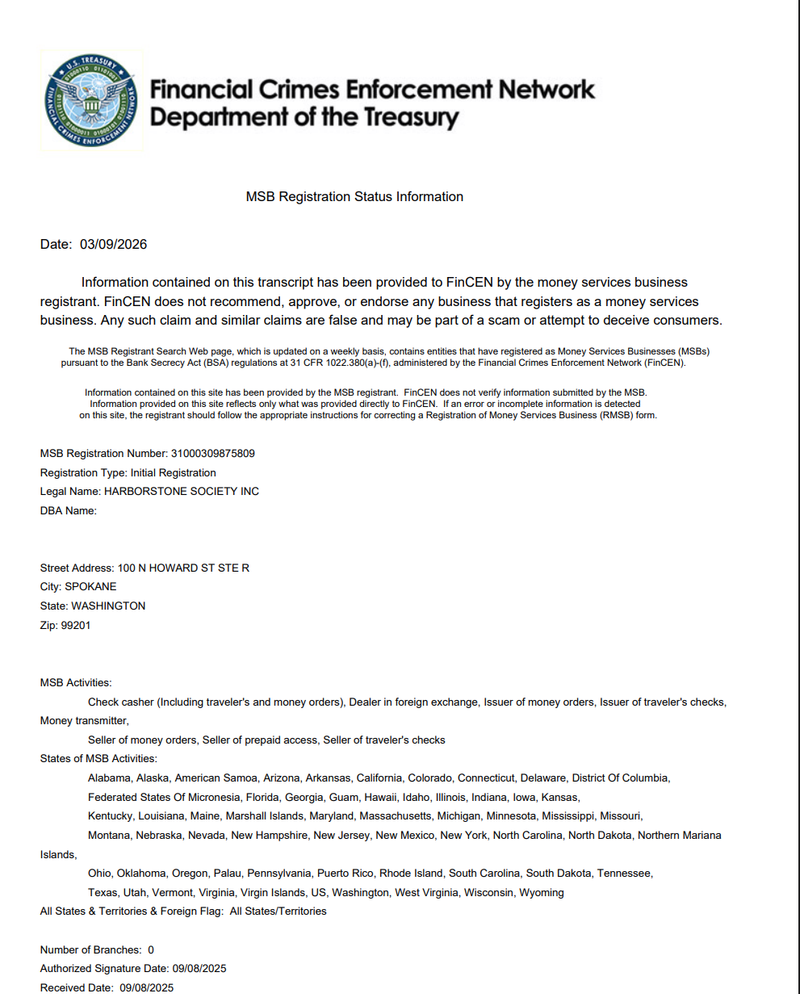
Records related to this platform are mainly concerned with U.S. Financial Crimes Enforcement Network (FinCEN) MSB (Money Services Business) registration.
MSB registration usually applies to business types such as:
- Money transmission services
- Currency exchange
- Issuance of traveler's checks or money orders
- Sale of prepaid cards
FinCEN clarifies on its official website that MSB registration does not constitute a government endorsement or approval of companies. This registration is primarily part of the anti-money laundering regulatory framework.
FinCEN also reminds the public that some institutions might create the impression of regulatory endorsement by advertising "MSB registration" even though this registration is not equivalent to securities trading or investment management licenses.
Contact Information and Address
Harborstone Society has disclosed contact information on its website:
- Email: [email protected]
- Address: 100 N Howard St, Rm R, Spokane, WA 99201-0508, United States
This address is located in Spokane, Washington, United States.

Social Media Presence
Currently, no official social media accounts of Harborstone Society have been found on open network platforms.
For a platform offering financial education or investment-related services, social media is typically used to publish event information, course updates, and industry perspectives.
Website Traffic Data
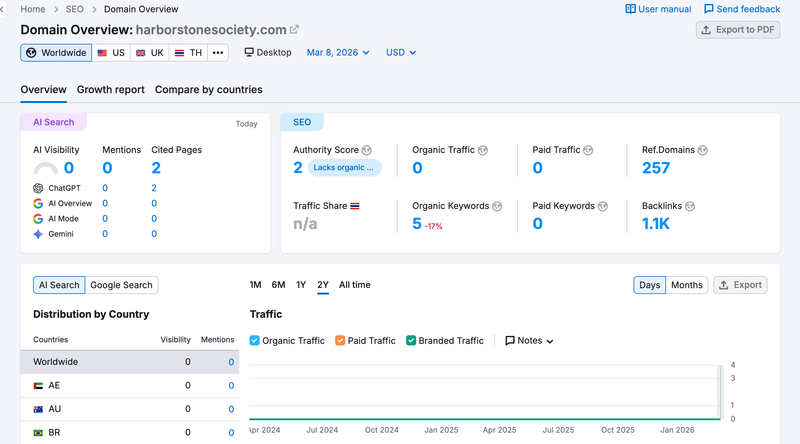
According to data from the third-party website Semrush, the visit volume of the Harborstone Society website is currently relatively low.
Public data shows that the website has limited average monthly visits, indicating a relatively small overall traffic scale.
Registration Process Evaluation
During the browsing test of the Harborstone Society website structure, the overall page layout appears to be quite organized, with a common tiered design for the navigation menu. The main columns, such as course introductions, research projects, and philosophical frameworks, are usually set at the top of the homepage, allowing users to quickly locate different information sections upon entering the site.
In terms of interface logic, the categories among the columns are relatively clear with a well-defined hierarchy. For example, educational courses, research directions, and project frameworks are usually presented independently, avoiding excessive concentration of information on a single page. This structure helps users in forming a clear reading path while browsing.
During actual browsing, page transition logic is generally intuitive. Users can progressively access more detailed introduction pages through the navigation menu or intra-page links, for example, from project overviews to core module descriptions of Erydon AILegacyX, and further to curriculum structures or research areas.
It is worth noting that the current public pages mainly focus on information display, with no obvious standardized account registration entry or user management system. Users interested in participating in courses or research projects usually need to further understand registration methods through the contact information or consultation channels provided by the website.
Overall, the Harborstone Society website has basic logical clarity in its information structure, but specific registration processes and participation mechanisms need further communication to gain more information.
Educational Resource Evaluation
Based on the publicly available information from the website, the educational content of Harborstone Society primarily revolves around financial theories, investment strategies, and risk management themes, with a curriculum system that covers multiple levels from basic learning to advanced research.
In terms of content design, the course structure is generally systematic. For example, basic courses mainly introduce financial market structures, investment principles, and risk management concepts; advanced courses gradually expand to more professional fields such as portfolio management, quantitative methods, and derivative strategies. This tiered structure helps learners with different backgrounds to gradually build a knowledge system.
However, in terms of teaching formats, existing content mainly consists of textual descriptions. The website includes a substantial amount of course introductions, philosophical explanations, and research content presented through text, while charts, data visualizations, or video instructional materials are relatively less prevalent.
In financial education, charts, case analysis diagrams, and strategy simulations often help learners to understand complex concepts more intuitively. For instance, portfolio allocation or risk models, if demonstrated graphically, are generally easier to comprehend. In comparison, text-dominated content might appear somewhat monotonous in reading experience.
Overall, while Harborstone Society's course themes are relatively comprehensive, there remains room for further enrichment in teaching presentation formats, such as adding illustrative case diagrams, data charts, or interactive learning materials.
Platform Information Disclosure Completeness
The transparency of information disclosure is a crucial criterion in evaluating financial platforms. Typically, platforms will publicly present essential information on their official websites, including company address, contact details, customer service channels, and operating entity.
In the publicly available information on the Harborstone Society website, an email is provided as a contact channel, such as a customer service email for user inquiries or communication. Email-based contact is fairly common on internet platforms, suitable for receiving user questions or handling general inquiries.
However, in some financial institutions or educational platforms, common communication methods also include phone support, online customer service systems, or multi-channel customer service interfaces to enable users to receive faster responses under different circumstances.
From an information disclosure perspective, having more communication channels and clearer information generally implies more transparent paths of communication between users and the platform. Thus, when evaluating any financial education platform, investors or learners will usually consider the completeness of its contact information and the transparency of its communication channels.
Platform Authenticity Self-Check
For any platform involving financial education or investment-related content, users typically need to perform basic background verification before participation. Accessing public database queries for company or regulatory information is a common method for self-checking.
The following methods can help users verify the public information of Harborstone Society:
Entity Information Verification
Users can query company information through the open database of U.S. securities regulators:
- Visit the U.S. Securities and Exchange Commission (SEC) official website
- Enter the relevant institution name or number into the query system
- Compare the company name, business information, and other content displayed by the system
This method can confirm whether there are corresponding entity records in the open database.
Regulatory Information Verification
If the platform mentions information related to anti-money laundering regulation, you can also query through the FinCEN system:
- Visit the U.S. Financial Crimes Enforcement Network (FinCEN) official website
- Enter the relevant registration number or company name into the MSB query system
- Compare the registration information with the platform's public information to check for consistency
It is important to note that MSB registration is primarily a record-keeping system under the anti-money laundering regulatory framework and is not equivalent to investment or securities business licenses.
Use Whois to Assess Domain Age
Besides regulatory information, domain history is often a common reference indicator when evaluating a website's background.
Users can use Whois query tools to learn about a website's domain registration time and basic information. The general steps are as follows:
- Visit whois.com or other Whois query platforms
- Enter the website domain
- Check the Creation Date in the domain information
- Calculate the age of the domain based on the registration time
This method can give a rough idea of the website's launch time and domain history.
Signals for Users to Be Cautious Of
When browsing any financial platform or investment-related website, users can usually make initial judgments using some basic signals, such as:
- Short Domain Registration Time: If the domain registration time is less than a year, it typically indicates that the website is relatively new.
- Inconsistency between Operating History and Domain Age: For example, the site claims to have been operating for several years, but the domain registration time is recent.
- Limited Information Transparency: Such as very little background info, contact details, or operating entity information about the company.
These signals do not necessarily indicate that there are problems with the platform, but understanding and verifying this information usually helps users make more cautious judgments in financial-related decisions.
Conclusion
Pros
- Well-Structured Educational Framework
Harborstone Society presents a systematic course structure in public information, from basic financial knowledge to advanced investment strategies to executive education training. The overall hierarchy is clear and can meet the needs of different learning stages. - Broad Range of Research Topics
The platform proposes research directions encompassing quantitative finance, risk management, global markets, behavioral finance, and sustainable finance, which are core topics of interest to the current financial industry. - Emphasizes Systematic and Long-Term Capability Development
The Erydon AILegacyX framework proposes ideas such as "Structure over Speculation" and "Learning through Application," emphasizing systematic analysis and long-term decision-making abilities. These concepts are common in financial education and help build a more rational learning approach. - Course Formats Include Research and Seminars
In addition to regular courses, the platform also mentions case studies, seminars, and global webinars, which are often used in financial education systems to foster discussion and knowledge exchange.
Cons
- Limited Regulatory Information
Public information shows that Harborstone Society is not subject to regulatory oversight by the U.S. Securities and Exchange Commission (SEC) for investment business, and its mentioned MSB registration mainly falls under an anti-money laundering framework, not equivalent to an investment or securities business license. - Overall Low Website Traffic
According to data from third-party traffic analysis tools, the site currently has a relatively limited visit volume, indicating a low level of activity in the public internet environment. - Lack of Social Media Information
No official Harborstone Society accounts were found on common social platforms. For financial education institutions, social media is generally used to publish course updates, event information, and research views, so the absence of relevant channels might affect information dissemination. - Relatively Single Teaching Content Presentation Format
From the website's content, teaching introductions are primarily text descriptions, with fewer charts, videos, or interactive learning materials. Diversified content presentation often enhances the learning experience in financial education.
Harborstone Society presents a system structure focused on financial education and research in its publicly available information. The course content and research directions cover multiple financial fields, emphasizing systematic learning and long-term decision-making capabilities. From an educational philosophy and curriculum structure perspective, its overall framework is rather complete. However, the platform still has room for improvement regarding regulatory disclosure, online activity, and information dissemination channels based on publicly available information. For users interested in this platform, verifying and assessing public data alongside understanding course content often helps provide more comprehensive reference information.
Disclaimer: The content of this article is based on public information and platform testing experience, and the actual effect may vary depending on market conditions.