


Against the backdrop of continuous integration between AI and blockchain, new projects centered around "skills datafication" and "learning assetization" are gradually emerging. Dydactix is introducing its solution in response to this trend, aiming to redefine the recording and verification of learning outcomes through on-chain credentials and AI assessment mechanisms.
According to public information, Dydactix has constructed an incentive system centered around the DAX token and designed a multi-module ecological structure covering learning, content production, and talent matching. This article systematically reviews its product architecture, token mechanism, and information transparency based on disclosed data.
Domain and Website Information
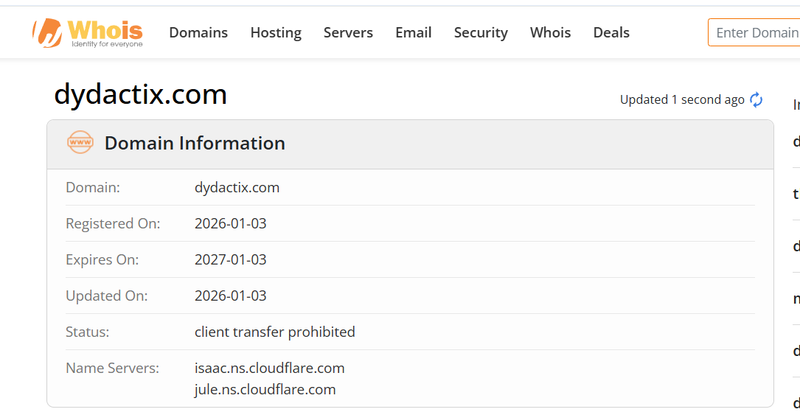
According to the Whois inquiry, the domain name of Dydactix's official website, dydactix.com, was registered on January 3, 2026, and it was updated on the same day.
From the website presentation perspective:
- The page structure is relatively simple
- The content mainly focuses on product philosophy and technical architecture
- The navigation logic is clear, allowing users to quickly locate core modules
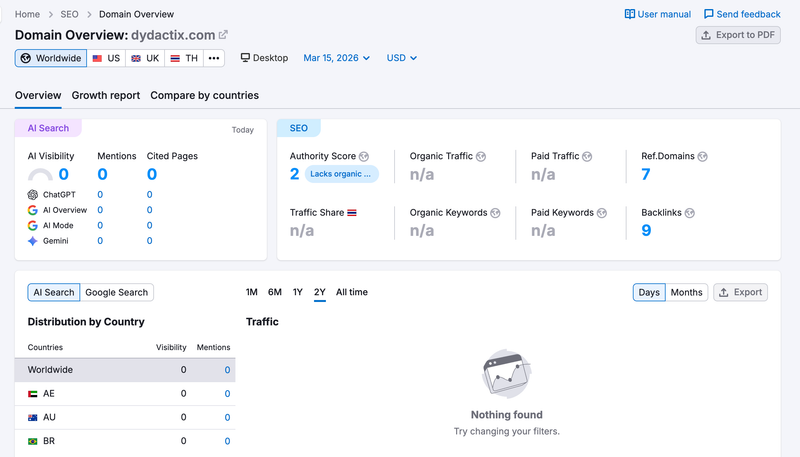
However, regarding traffic data, based on Semrush data, current monthly visits to the site are relatively low, and overall user activity is still in the early stages.
Core Products and Ecological System
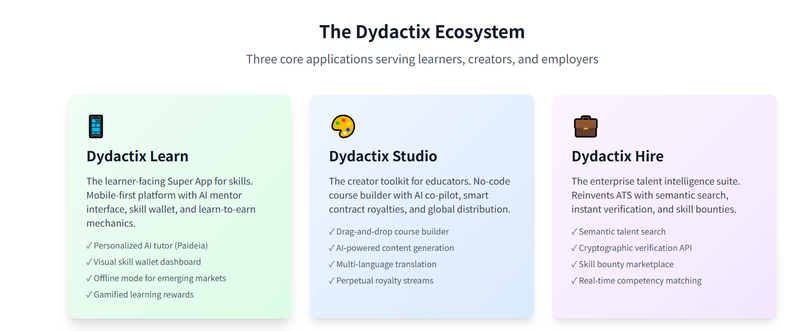
The Dydactix ecosystem revolves around three main products corresponding to learning, content production, and employment scenarios.
Dydactix Learn: Learning and Certification Platform
This module mainly supports the learning process and skill certification. After users complete learning on the platform, their abilities can be system-evaluated and generate the corresponding on-chain credentials (dCred).
Dydactix Studio: Content Creation Platform
Studio is aimed at educational content creators, allowing them to publish courses or learning paths and earn through the platform. The value of the content is determined by both usage and verification results.
Dydactix Hire: Talent Matching System
The Hire module connects enterprises with talents. Employers can screen candidates based on on-chain skill credentials, reducing reliance on traditional academic or resume credentials.
Overall, these three form a closed-loop system from "skill production - verification - application."
DAX Token Mechanism Analysis
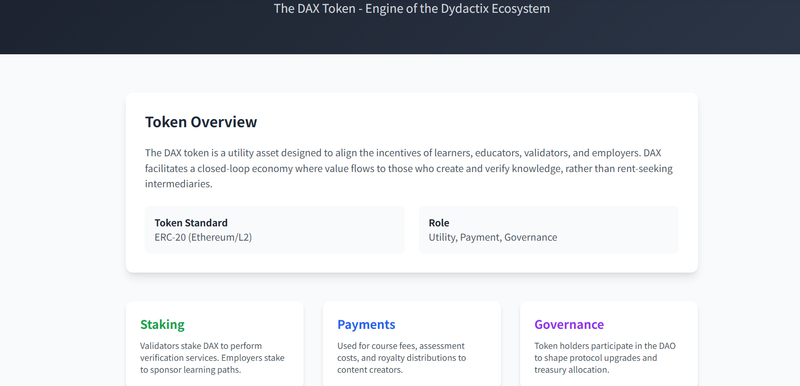
DAX is the core token within the Dydactix ecosystem, serving multiple functions such as payment, incentives, and governance.
Token Functionality
- Payment Tool: Used for course fees, evaluation fees, and for splitting earnings with content creators
- Staking Tool: Validators need to stake tokens to participate in validation, and employers can stake to support learning paths
- Governance Tool: Token holders can participate in DAO decisions
Incentive and Governance Logic
DAX is designed to coordinate the interests of different participants in the ecosystem:
- Learners receive skill credentials by completing courses
- Validators earn rewards through staking and assessments
- Content creators earn through course usage
This mechanism aims to reduce intermediary roles, distributing value more effectively to actual contributors.
Technical Architecture Breakdown
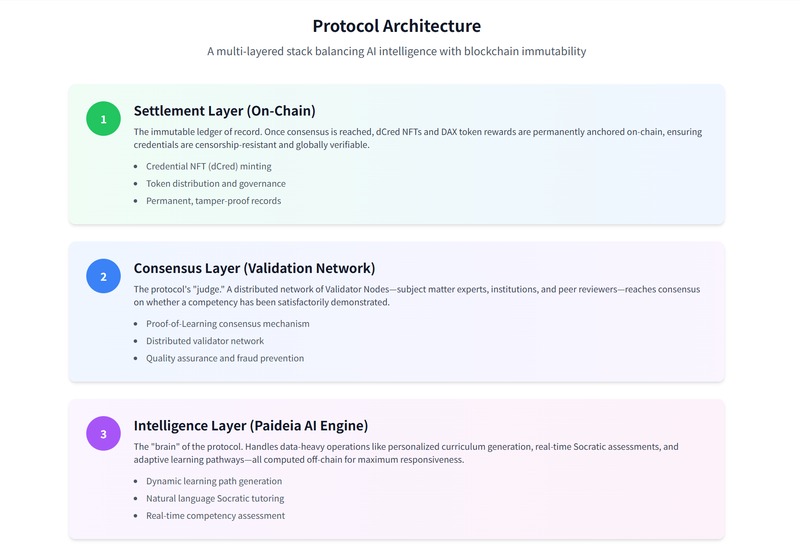
Dydactix employs a multi-layer architecture, layering blockchain and AI capabilities.
Settlement Layer (On-chain)
This layer records all critical data, including:
- Minting of dCred NFTs
- Token distribution
- Governance decision records
It is characterized by immutability, ensuring long-term verifiability of credentials.
Consensus Layer (Validation Network)
Comprising distributed validation nodes including experts, institutions, or peer reviewers, its role is to audit learning outcomes and reach consensus.
This mechanism is used to achieve:
- Skill verification
- Quality control
- Fraud prevention
Intelligent Layer (Paideia AI Engine)
As the "computational core" of the system, this layer mainly operates off-chain for processing high-frequency data and complex logic, including:
- Personalized learning path generation
- Natural language tutoring
- Real-time capability assessment
This combined on-chain and off-chain design enhances efficiency while reducing on-chain computational costs.
Core Ideas of the White Paper
According to the white paper, Dydactix's core goal is to create a globally applicable "skills passport" system.
Its logic can be summarized as:
- Transforming the learning process into verifiable assets (dCred)
- Authenticating skills via a distributed validation network
- Connecting education and employment through a token mechanism
The project believes that the traditional educational system has efficiency issues in skill certification and market alignment, and on-chain credentials and AI assessments may provide a new solution pathway.
Regulatory and Entity Information
Currently, no definitive regulatory information or verifiable operational entity registration records for Dydactix have been found in the public domain.
Additionally:
- No clear corporate entity information was found
- No specific registration area or legal entity has been disclosed
In the financial or digital asset platforms, the verifiability of the operating entity is typically fundamental information, and the currently available data is relatively limited.
Website Traffic
According to Semrush data, Dydactix currently has low website traffic and limited overall scale. This usually indicates that the platform is still in the early stages and the user base has not yet formed a scale.
Social Media Status
In public channels, no definitive social media accounts or community entries for Dydactix have been found.
In Web3 projects, social media is typically used for:
- Project updates
- Community interaction
- User feedback collection
Therefore, the absence of this information makes it difficult for external observers to obtain continuous platform dynamics or user participation status.
Enrollment Process Evaluation: Interface Structure and User Path
Based on the website structure, Dydactix leans towards a minimalist style with intuitive navigation logic. The main functional modules are usually concentrated in the top navigation bar, allowing users to quickly locate core entries such as product introduction, token information, or ecosystem modules.
Specific experience:
- Clear Navigation Hierarchy: The primary menu is clearly divided without excessive nested levels, helping users quickly understand platform structure
- Intuitive Functional Areas: Different sections are clearly separated with concentrated content presentation, reducing information interference
- Product-Oriented Information Organization: The page focuses mainly on protocol architecture and token mechanism introductions rather than user operation procedures
However, from a user perspective, such a structure is more suitable for users with a certain cognitive foundation. For new users encountering the platform for the first time, although they can "see the content," they may not quickly understand "what to do next," such as how to register, participate, or start using the product.
This type of design is common in Web3 projects, emphasizing concept and architecture display but downplaying the "process-guided design" in traditional financial platforms.
Evaluation of Educational Resources: Lack of User Support System
Regarding educational resources, no systematic learning support content from Dydactix was found, such as:
- Beginner's guide (e.g., "How to Start Using the Platform")
- Basic concept explanations (e.g., token mechanisms, validation process descriptions)
- Risk warnings or operational guides
- FAQ or help center
This means that users primarily rely on white paper or product introduction to understand platform logic during initial exposure.
From a user experience perspective:
- For users with a blockchain or Web3 background, this information structure is still readable
- But for ordinary users or novice investors, the lack of basic guidance may raise understanding barriers
In mainstream financial or trading platforms, educational resources are often seen as an essential part of lowering the user entry barrier. Therefore, the lack of this part may affect platform usability and user expansion capability.
Platform Information Disclosure Completeness: Basic Information Transparency
From the public page, Dydactix has certain gaps in basic information disclosure, mainly reflected in:
- Not explicitly listing company registered address
- Not providing verifiable contact number or customer service channels
- Lack of clear operational entity explanation
In standard financial platforms or compliant trading services, the following information is usually provided:
- Name and location of the registered entity
- Contact methods (email, phone, or online customer service)
- Legal terms and user agreements
These details are not only to meet regulatory requirements but also help users establish communication channels when issues arise.
Currently visible information shows Dydactix's disclosure is relatively limited. This situation is not uncommon in some early Web3 projects, but from a user perspective, information transparency still has room for improvement.
Using Whois to Assess Domain Longevity: Basic Credibility Indicator
Domain information is a basic tool for assessing a platform's "historical presence." By querying Whois, you can obtain key data such as the website's registration time and update time.
Standard evaluation steps are as follows:
- Visit the Whois query tool (e.g., whois.com)
- Enter the platform domain (e.g., dydactix.com)
- Check the "Creation Date"
- Calculate the domain's existing time
According to existing information:
- The Dydactix domain registration date is 2026-01-03
- The latest updated date is also 2026-01-03
This indicates that the domain is in a relatively new registration phase.
In industry practice, domain longevity is often used as an "auxiliary judgment indicator" to observe a platform's historical continuity, but it alone cannot directly represent platform quality or legality.
Basic Signals Users Need to Focus On: How to Identify Information Consistency
When evaluating similar platforms, users typically focus on the following basic signs, which are not direct conclusions but assist in judging information consistency:
- Short domain registration time (less than 1 year)
May imply a platform is in the early stage, with little historical data - Inconsistency between platform publicity time and domain time
If a platform claims "years of operation" but the domain was just registered, further investigation is needed - Overall limited information transparency
Includes lack of entity information, contact methods, or public disclosure materials
These factors alone do not constitute a direct judgment basis, but when multiple signals appear simultaneously, they often prompt users to conduct more in-depth information verification, such as checking on-chain data, project team background, or third-party evaluations.
Conclusion
Pros
- Conceptual Structure is Relatively Complete: Dydactix builds a closed-loop ecosystem around "learning - verification - employment," demonstrating some systematic logic
- Clear Technical Route: Combining AI (Paideia engine) and blockchain in a layered manner, balancing efficiency and verifiability
- Token Mechanism Has Functional Design: DAX plays a clear role in payment, staking, and governance, forming a certain incentive loop
- Application Scenarios Have Real-world Orientation: Attempting to solve skill certification and recruitment matching issues, demonstrating some real-world need basis
- Product Structure Distinctly Divided: The three modules Learn, Studio, Hire correspond to different user roles with clear functional positioning
Cons
- Lack of Disclosure on Entity and Regulatory Information: No clear company registration information or regulatory background found, with limited basic information transparency
- Short Domain History: The website registration time is quite new with limited historical data to reference
- Low Platform Activity: Current website traffic is limited, and user scale and market participation are still unclear
- Lack of Social Media and Community Entry: Few external communication channels, which is not conducive to continuous information acquisition and user interaction
- Insufficient Education and User Guidance: No systematic beginner's guide or help resources, presenting understanding barriers for ordinary users
Conclusion
Overall, Dydactix shows a certain completeness in concept and architecture design, especially in combining skill verification with on-chain credentials, indicating a clear direction. However, based on currently available public information and platform visibility, it is still in an early stage, with some foundational information disclosure and user support systems yet to be perfected. For users focusing on such projects, understanding its technical logic should be combined with further observation and judgment based on the completeness of public information.
Disclaimer: The content of this article is based on public information and platform testing experience, with actual effects possibly varying due to market conditions.

