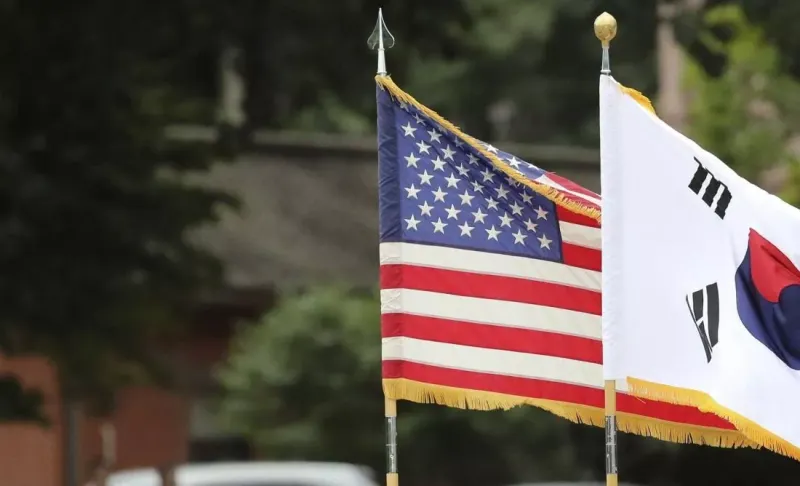
The U.S.-South Korea Trade Agreement Brings Market Respite as Korean Financial Authorities Conduct Intensive Consultations
On October 31, Seoul time, the South Korean government stated that after the latest U.S.-South Korea trade agreement was reached, initial signs of stabilization appeared in the domestic foreign exchange market, with the won-dollar exchange rate fluctuations calming down. However, Korean officials also warned that the international macroeconomic environment remains complex, and the risk of external shocks has not completely dissipated.
According to a joint statement from South Korea's Ministry of Finance, the Bank of Korea, the Financial Services Commission, and the Financial Supervisory Service, an emergency meeting was held to focus on discussing the impact of the U.S. Federal Reserve's latest interest rate cut, the end of quantitative tightening, and their effects on the won and capital markets.
The statement noted that the South Korean stock and bond markets have shown short-term stability, with some investors reentering the risk asset market. However, government officials also stressed that market sentiment remains fragile, and if external uncertainties intensify, volatility could rise again.
South Korean Won Stabilizes but Remains Under Pressure, Fed Policies Seen as Key Variable
Meeting minutes reveal that the Bank of Korea believes market expectations have settled after the Fed's consecutive 25 basis point rate cuts; however, the strong dollar trend has yet to reverse. While the won rebounded about 0.3% from this week's lows against the dollar, it remains in a weak range seen over the past three months.
In an independent statement, the Bank of Korea noted: “Although the Fed's policy adjustments align with market expectations, significant uncertainty remains regarding future interest rate paths. If U.S. inflation rebounds or job data strengthens, it could delay the pace of rate cuts and impact capital flows to emerging markets.”
Analysts believe that the recent stabilization of the won partly benefits from the confidence boost brought by improved trade relations. OCBC foreign exchange strategist Lim Siaw said, “After the U.S. and South Korea reached a trade agreement, investors believe that reduced bilateral trade barriers will help stabilize export expectations and indirectly support the won.”
South Korean Authorities Strengthen Policy Coordination, Monitor Capital Flows and Market Signals
South Korean finance ministry officials told the media after the meeting that the government will continue to maintain a multi-departmental coordination mechanism to tackle potential market fluctuations. He emphasized that the policy team is closely observing cross-border capital flows and will take “market-friendly intervention measures” if needed.
Meanwhile, the Financial Services Commission of Korea noted that although short-term markets have stabilized, risk premiums remain high. In particular, influenced by fluctuations in U.S. Treasury yields, some foreign capital remains in a wait-and-see phase.
“We will continue to monitor the capital markets' reactions and maintain policy communication with major central banks if necessary,” said a Financial Services Commission spokesperson. “Stability in the foreign exchange market is crucial for macroeconomic confidence.”
External Risks Remain High, Trade and Fiscal Issues Could Be Hidden Dangers
The South Korean government mentioned in a statement that the current external risk factors impacting the market mainly include global trade frictions, uncertainties in the Fed's policy path, and potential long-term shutdown risks in the U.S. government.
Additionally, some officials are concerned that if fiscal expansion intensifies in major economies, it could trigger repricing of funds, causing volatility shocks to export-oriented economies like South Korea.
Professor Park Jae-hun of Seoul National University’s Department of Economics pointed out, “The stability of the Korean market depends on whether global financial conditions remain loose. If the Fed pauses rate cuts or eurozone growth slows, the won may still face pressure.”
Cautious Optimism in Policy Defense
Despite positive short-term signals, South Korean officials remain cautious. Bank of Korea Deputy Governor Kim Tae-hyung stated that in the coming weeks, the focus will be on monitoring foreign exchange volatility and short-term capital inflow data to ensure the financial system is not impacted by speculative capital shocks.
“We observe preliminary signs of stabilization but must not misjudge the situation. The market is still in a fragile equilibrium, and policies need to remain flexible and forward-looking,” Kim Tae-hyung added.
Industry analysts generally believe that the easing of U.S.-South Korea trade relations has instilled confidence in the market mood, but true stability still hinges on the direction of the global monetary environment. If the Fed continues to send dovish signals at the December meeting, the won and South Korea's capital markets may experience a more prolonged respite period.
South Korea’s financial circle agrees that this trade agreement is merely the “starting point of stability” rather than the end. Facing global economic slowdown and policy uncertainties, South Korea still needs to maintain a coordinated defense with fiscal and monetary policies to ensure that recovery steps are not disrupted by external risks.