
• Home
  • Categories
  • News
  • Community
EN
EN
Home
CategoriesNewsGlossaryCommunityAbout Us
Contact Us
Social Media
Region
🌏International
Region
🌏International

Copyright © 2023-2026 Traderknows Ltd. All rights reserved.

Contact
Home
/
News
/
Yellow's bankruptcy is just the tip of the iceberg in the U.S. freight decline.

Yellow's bankruptcy is just the tip of the iceberg in the U.S. freight decline.

TraderKnowsTraderKnows
2024-05-06
Summary:Data from Cass indicates that the self-operating fleets of large corporations, such as Walmart and Amazon, are encroaching upon the freight demand traditionally met by truck leasing companies.

Every downturn in the freight industry plunges precarious freight companies into difficulty. This time, the downfall of the freight industry might be long-term and sustained, symbolized by the bankruptcy liquidation of Yellow, the largest bankruptcy case in the history of the freight industry. During the last freight recession, many trucking companies went bankrupt, including Celadon, which closed due to accounting fraud.

The decline in the freight industry began during the pandemic control period when consumers shifted some of their spending from goods to services such as tourism, which do not require truck transportation.

More critically, the formation of in-house transportation fleets by large corporations has dealt a fatal blow to the freight industry. Data from Cass shows that the proprietary fleets of major companies like Walmart and Amazon are eroding the freight demand that was previously met by leasing truck companies.

Cass indicates that the expansion of corporate-owned fleets is squeezing the living space of the freight industry. Until the growth momentum of these private fleets slows down, the freight industry is unlikely to see a positive turnaround.

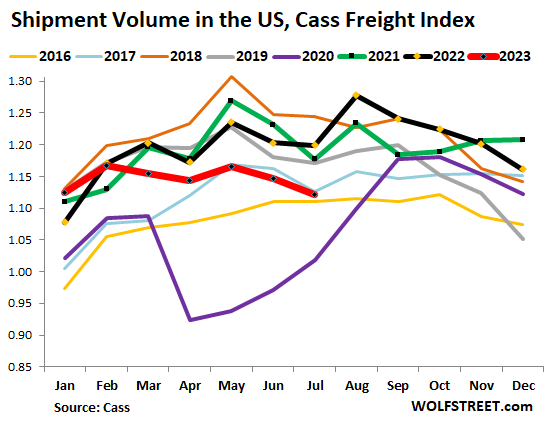
Looking at the freight volume of the industry, including rail, truck, and other modes of transport, the Cass Freight Index saw another decline in July, marking not only the worst performance since July 2020 but also since July 2016. The Index fell by 8.9% compared to the same period last year and dropped 12% from the peak cycle in May 2021.
Freight 1

In the Cass Freight Index, truck freight accounts for more than half of the weight, followed by rail freight, parcel services (such as UPS and FedEx), and others. Data shows that UPS's daily parcel volume decreased by 9.9% in the second quarter and by 12.2% in June. FedEx's daily shipment volume in the second quarter fell by 18%.

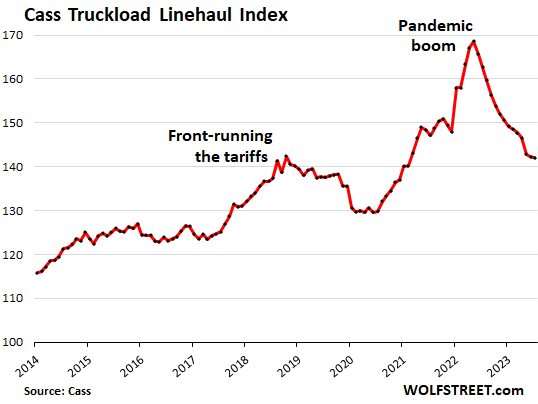
The decrease in freight volume has dragged shipping rates to rock bottom. The Cass Truckload Linehaul Index shows that after seasonal adjustments, the spot and contract rates for full truckloads (excluding fuel and other fees) have declined for the 14th consecutive month in July, a 12.7% year-over-year decrease, and a 15.8% decrease from the peak in May 2022.
Freight 2

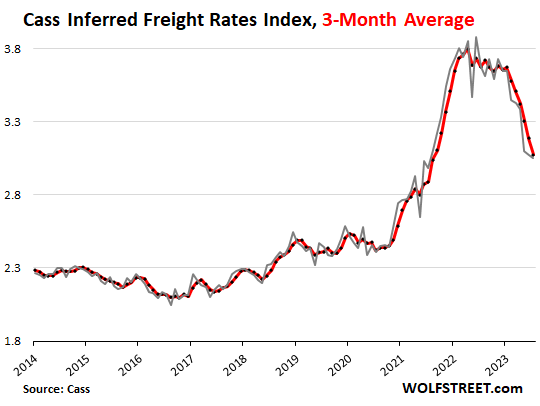
The Cass Inferred Freight Rates Index inclusive of fuel charges continued its downward trend in July, falling 21% from the peak in June 2022.
Freight 3

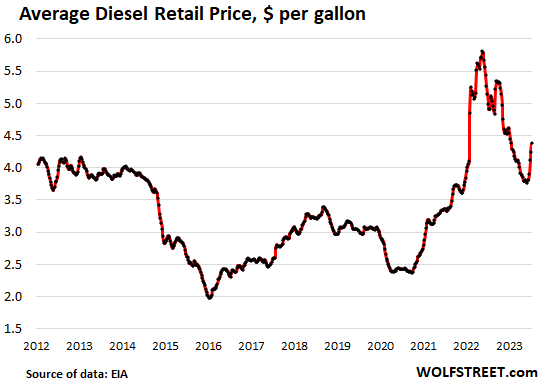
Between June 2022 and June 2023, diesel prices slid, exerting significant downward pressure on shipping rates. Recently, although there have been signs of a rise in diesel prices, the current prices provide weak support for shipping rates, and changes in fuel costs and other expenses have little effect on reversing the downward trend in the freight industry's volume and price.
Freight 4

Risk Warning and Disclaimer

The market carries risks, and investment should be cautious. This article does not constitute personal investment advice and has not taken into account individual users' specific investment goals, financial situations, or needs. Users should consider whether any opinions, viewpoints, or conclusions in this article are suitable for their particular circumstances. Investing based on this is at one's own responsibility.

The End
Previous
Next
Comments
0/1000
TraderKnows
Written byTraderKnows
Created date:2023-08-15 06:45
Last Updated:2024-05-06 09:18
Independent Analysis: Manually researched and fact-checked by the TraderKnows Compliance Team, based on public regulatory records.
Wiki
Nominal Prices

It refers to the price of goods, products, or assets expressed in monetary units over a specific period, without adjustment or consideration for inflation.

Recent Post

Trump Invokes Defense Production Act with 850 Million USD for Coal Power to Meet AI Demand

06-05

NY Fed Index Shows High Supply Chain Pressures as Geopolitical Conflicts Raise Global Inflation Con…

06-05

Japan's Real Wages Rise for Fourth Consecutive Month, Fueling June BOJ Rate Hike Bets

06-05

China Flexible Employment Exceeds 300 Million as Blue-Collar Wage Growth Outpaces White-Collar for…

06-05

South Korean Stocks Post Steepest Weekly Drop Since March as Tech Valuations Reset

06-05

China Commercial Paper Rates Drop in Early June Amid Rising Bank Demand

06-05

UK House Prices Unexpectedly Fall in May as Geopolitical Tensions Push Up Borrowing Costs

06-05

Massive Intervention Fails to Save Yen as Short Positions Surge Near Historic Lows

06-05

AI Momentum Pauses as Broadcom Outlook Misses High Expectations; Markets Await Payrolls

06-05

SpaceX Launches 75B USD IPO Roadshow as Access Blocked in Mainland China and Hong Kong

06-05

Global Gold ETFs See $2 Billion Outflows in May as Capital Pivots to Tech Assets

06-05

Nikkei Drops Over 1% on Tech Sector Pullback While Real Wage Growth Provides Support

06-05

South Korea Lifts Mandatory Reporting for Crypto Transfers Over 10M Won

06-05

Amundi Says Asian AI Stocks Supported by Fundamentals as Fed Path Poses Key Risk

06-05

Taiwan Stocks Close 1.33% Lower on Broadcom Drop But Hold Key Technical Support

06-05

Risk Warning

TraderKnows is a financial media platform, with information displayed coming from public networks or uploaded by users. TraderKnows does not endorse any trading platform or variety. We bear no responsibility for any trading disputes or losses arising from the use of this information. Please be aware that displayed information may be delayed, and users should independently verify it to ensure its accuracy.