

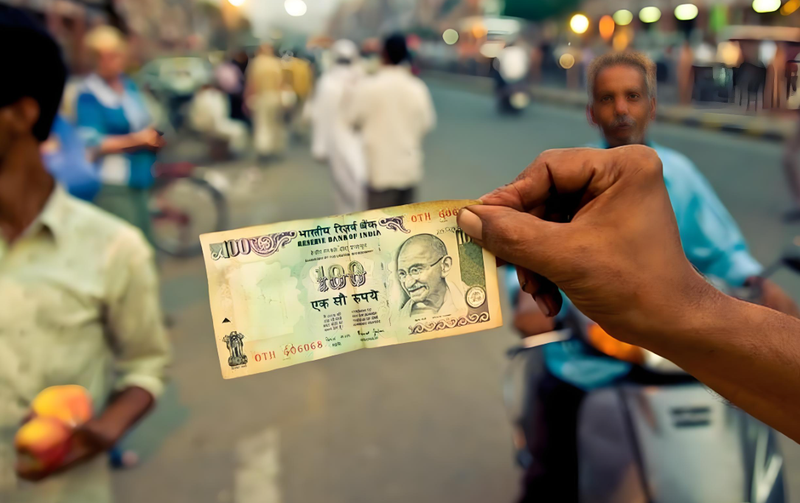
Rupee's Historical Low Sparks Market Turmoil
The Indian foreign exchange market is under renewed pressure. On Monday, the Indian rupee hit a historic low against the US dollar, breaking its previous record. This trend marks a continued weakening of the rupee in a short period and reflects eroding confidence in India’s external environment and capital flows.
The rapid decline not only hit a psychological barrier but also exacerbated market volatility to some extent, prompting investors to be more cautious in their short-term risk assessments of Indian financial assets.
Stalled Trade Talks Weigh on Market Sentiment
Analysts point out that a core reason for the rupee's weakness is the protracted trade negotiations between India and the United States. The lack of breakthrough on key issues such as tariff arrangements and market access has led the market to adopt a wait-and-see attitude towards the future of bilateral trade relations.
In an already uncertain global trade environment, the slow progress in talks is viewed as a potential negative signal, undermining external investors' confidence in India's export and economic growth potential.
Continued Foreign Capital Outflow Exacerbates Exchange Rate Pressure
Apart from trade factors, changes in capital flows have directly impacted the rupee. Recently, overseas investors have been consistently reducing their holdings in Indian stocks and bonds, highlighting a clear trend of capital outflow.
In a global interest rate environment still deemed attractive, with rising returns in some developed markets, emerging markets face intensified competition for capital. As one of the markets with significant inflows, India's asset prices and exchange rate are particularly sensitive to foreign capital movements.
Strong Dollar Amplifies Emerging Markets' Volatility
From an external perspective, the strong dollar is also applying broad pressure on emerging market currencies, including the rupee. A robust dollar typically accompanies the return of global funds to core markets, reducing the allocation to high-volatility assets as risk appetite decreases.
Against this backdrop, the rupee's decline is not entirely isolated but a component of the global capital rebalancing process. However, trade negotiations and local capital outflows make its condition more fragile.
RBI Faces Policy Dilemma
The persistent weakening of the rupee presents new policy challenges for the Reserve Bank of India (RBI). On one hand, a depreciating currency can boost export competitiveness; on the other hand, a rapid depreciation might increase import costs, adding inflationary pressures and affecting market stability.
In previous rounds of volatility, the RBI typically adopted a gradual intervention strategy to smooth out excessive fluctuations rather than attempting to reverse long-term trends. The market is keenly observing whether the authorities will employ foreign exchange operations or liquidity management to slow the short-term depreciation.
Businesses and Investors Respond Cautiously
For businesses, a falling rupee heightens the importance of foreign exchange risk management. Industries with high import dependencies face rising cost pressures, while companies with substantial foreign debt must address changing repayment costs.
At the investor level, the rupee's record lows compel the market to reassess the risk-return ratio of Indian assets, likely curbing new capital inflows in the short term until clearer improvement signals appear in policies or external environments.
Outlook Depends on Multiple Factors
Overall, the rupee's new historic low is a result of stalled trade talks and capital outflows acting in concert. The future trajectory will largely depend on whether the US-India trade discussions make progress, shifts in global capital flows, and how the RBI responds to market volatility.
With uncertainty still prevalent, the rupee's volatility is expected to remain high, and the market's sensitivity to policy signals and external events will increase significantly.

