
• Home
  • Categories
  • News
  • Community
EN
EN
Home
CategoriesNewsGlossaryCommunityAbout Us
Contact Us
Social Media
Region
🌏International
Region
🌏International

Copyright © 2023-2026 Traderknows Ltd. All rights reserved.

Contact
Home
/
News
/
Data shows that Japan is winning its decades-long battle against deflation.

Data shows that Japan is winning its decades-long battle against deflation.

TraderKnowsTraderKnows
2024-05-08
Summary:Rising commodity prices and a tight job market have pushed inflation up, increasing consumer worries over living expenses. Japan's government's tone shift on deflation reflects a new focus.

On Tuesday, the Japanese government stated that Japan could be at a turning point in its decades-long struggle against deflation, as signs of faster price increases and wage growth emerge. This comment signifies the government's confidence that the Japanese economy is nearing an end to long-standing stagnation and deflationary pressures.

The optimistic statements from the Japanese government echo the views of the Bank of Japan (BOJ), which has mentioned that changes are happening in the way businesses set prices and wages, potentially paving the way for gradual withdrawal of the country's massive fiscal and monetary policies.

In its annual economic white paper, the Japanese government stated that since the spring of 2022, the extent of price and wage increases in Japan has expanded, marking a crucial turning point in the 25-year-long battle with deflation.

The government noted that, although the growth rate of service prices reflecting domestic demand and wage levels remains modest and the risk of deflation has not been completely eliminated, the perception of continual price drops among consumers is weakening due to rising inflation and wages, indicating that the opportunity to escape deflation should not be overlooked.

Rising commodity prices and a tight job market are driving inflation, heightening public concern over increasing living costs. The change in tone when discussing deflation risk highlights a shift in focus for the Japanese government.

Affected by an increasing number of businesses passing on higher raw material costs to consumers and providing the highest salaries for employees in 30 years, Japan's core inflation rate reached a 40-year high of 4.2% in January, staying above the BOJ's 2% target for 16 consecutive months.
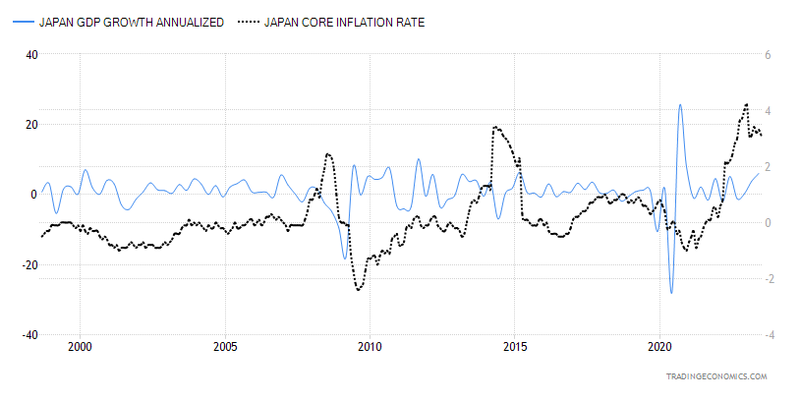
Japan Inflation

However, the Japanese government has not yet declared an end to deflation. It stated in its annual economic white paper that clear signs indicating Japan will not return to a period of falling prices, and the elimination of a persistent deflationary mindset among households and businesses, are necessary for Japan to fully emerge from decades of economic malaise and deflation.

Since entering a state of deflation in 2001, preventing price declines, boosting economic vitality, and increasing inflation levels have been top policy priorities for the Japanese government. This focus has led the government to increase fiscal spending for many years and demand that the central bank maintain ultra-loose monetary policies to stimulate the sluggish economy and price levels.

Risk Warning and Disclaimer

The market carries risks, and investment should be cautious. This article does not constitute personal investment advice and has not taken into account individual users' specific investment goals, financial situations, or needs. Users should consider whether any opinions, viewpoints, or conclusions in this article are suitable for their particular circumstances. Investing based on this is at one's own responsibility.

The End
Previous
Next
Comments
0/1000
TraderKnows
Written byTraderKnows
Created date:2023-08-29 03:24
Last Updated:2024-05-08 08:27
Independent Analysis: Manually researched and fact-checked by the TraderKnows Compliance Team, based on public regulatory records.
Wiki
Deflation

Deflation refers to the phenomenon where the supply of money is less than the actual demand for money in circulation, causing the value of money to appreciate, which in turn leads to a continuous decline in the overall price levels of goods and services.

Recent Post

Taiwan Dollar Extends Gains for Second Day as Foreign Funds Reverse Net Selling

15 hours ago

US Listed Private Credit BDCs Cut Dividends as Cash Coverage Weakens

15 hours ago

Goldman Sachs Cuts 2027 Brent Oil Forecast to $80 on Strong Supply and Weak Demand

15 hours ago

US Appeals Court Rejects Motions Against Mountain Valley Southgate Pipeline Project

15 hours ago

US Natural Gas Prices Slump to Two Week Low on Storage Surge and Export Plant Maintenance

15 hours ago

SEC Delays SpaceX Leveraged ETFs to Monday to Avoid IPO Complications

15 hours ago

RMB Hits Near 3.5-Year High as US-Iran Peace Prospects Boost Risk Appetite

15 hours ago

Bund Yields Slip but Traders Stick to ECB Rate Hike Bets After Historic Move

15 hours ago

BofA Raises Server CPU Market Forecast as Agentic AI Shifts Hardware Ratios

15 hours ago

ECB Hikes Rates for First Time in Three Years as Global Central Banks Shift Stance

15 hours ago

US and Iran May Sign Peace Deal This Weekend as Strait of Hormuz Reopening Eyes Energy Markets

15 hours ago

SpaceX Lists on Nasdaq with Record $75 Billion IPO to Test $1.77 Trillion Valuation

15 hours ago

US Natural Gas Prices Hit Two-Week Low on U.S. Inventory Build and LNG Maintenance

15 hours ago

Oil Prices Drop Over 2% as Trump Cancels Iran Strike Plan and OPEC Lowers Demand Forecast

15 hours ago

Copper and Base Metals Rally on Hopes of US-Iran Peace Agreement

15 hours ago

Risk Warning

TraderKnows is a financial media platform, with information displayed coming from public networks or uploaded by users. TraderKnows does not endorse any trading platform or variety. We bear no responsibility for any trading disputes or losses arising from the use of this information. Please be aware that displayed information may be delayed, and users should independently verify it to ensure its accuracy.