

Data from S&P Global Ratings shows that in June and July this year, the new home sales of China's top 100 real estate developers fell by about one-third year-on-year, whereas earlier this year, the increase was in double digits.
The looming default of real estate giant Country Garden has exacerbated the financing difficulties for real estate developers, sparking concerns about a crisis spreading across China's real estate industry. Meanwhile, the world's most indebted real estate developer, Evergrande, filed for bankruptcy protection in the US, further shaking investor confidence.
China's real estate woes are intensifying, with the "disappearance" of potential buyers leading to weak sales and investors eagerly hoping for policymakers to intensify support for the industry. Edward Chan, director at S&P Global Ratings, said that due to most apartments in China being sold before completion, weak new home sales could pose serious cash flow problems for developers. He believes that without any improvement in new home sales, especially with the ongoing risk of Country Garden's default and Evergrande's bankruptcy, the risks in China's real estate market could be further exacerbated.
The crisis of confidence triggered by the real estate industry is increasing the pressure on China. It is estimated that the real estate industry accounts for one-quarter of economic activity in China, either directly or indirectly. JPMorgan raised its forecast for defaults on high-yield bonds of global emerging market companies on Tuesday, mainly due to growing concerns that the Country Garden incident could affect other Chinese real estate developers.
Country Garden, the largest non-state-owned real estate developer in China by sales, failed to pay a $22.5 million coupon on a dollar bond due on August 7. Last week, the property company suspended trading of 11 domestic bonds and warned that its expected half-year loss could reach 55 billion yuan ($7.5 billion).
In 2020, China introduced the "three red lines" policy for mainland real estate developers, which requires developers to meet three specific balance sheet conditions if they wish to take on more debt, based on the company's cash flow, assets, and capital levels to control debt size. This policy, along with the "housing is for living, not for speculation" policy, has not only hit real estate developers but also led to several years of downturn in the entire real estate industry.
On Tuesday this week, JPMorgan said in a report that Country Garden's default could add $9.9 billion to the total defaults of high-yield companies in global emerging markets in the first half of the year, bringing the total defaults in China's real estate industry to $17 billion so far in 2023. The American investment bank predicts that by 2023, Chinese real estate will account for nearly 40% of the total defaults in emerging markets.
Many of Country Garden's problems are related to its excessive investment in underdeveloped areas of China (i.e., second and third-tier cities). According to the company's 2022 annual report, about 61% of its development projects are located in these cities, where housing supply exceeds demand. Chan stated that affected by weak sales in both first-tier and second and third-tier cities, real estate sales in June and July fell by about 50% year-on-year. And this year's overall real estate sales in China are getting further away from S&P's estimated range of 12 trillion to 13 trillion yuan.
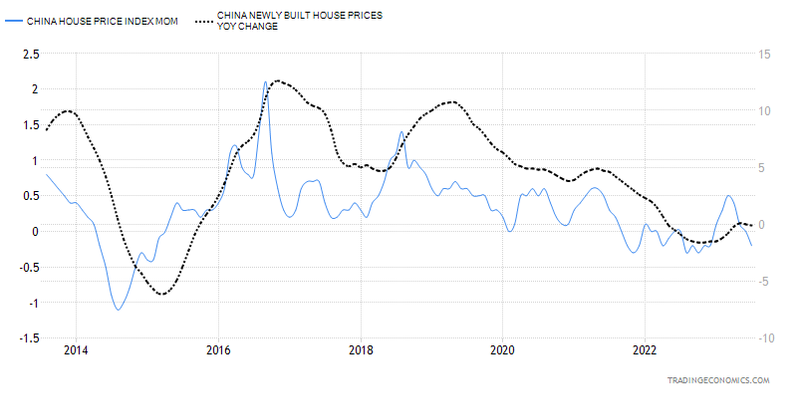
Louise Loo, Chief Economist at Oxford Economics, stated in a report on August 11 that Country Garden's debt problem and government support uncertainty are exacerbating the general unease and loss of confidence in China's real estate market.
However, as the Chinese real estate industry consolidates its debt and credit issues, state-owned real estate developers not only have a greater ability to achieve growth targets but also a stronger capacity to withstand risks and uncertainties compared to non-state-owned developers. Data from Natixis Corporate and Investment Banking show that in the first seven months of this year, state-owned developers saw a 48% year-on-year increase in contracted sales, while non-state-owned developers saw a 19% decrease.
The sales performance of state-owned real estate developers not only strengthens their cash flow and ability to withstand risks but also enhances their ability to purchase land from local governments. According to Natixis data, by July, state-owned developers had purchased 87% of the land by value, a significant increase from the 59% level in 2021.
Gary Ng, a senior economist at Natixis, stated that in the future, state-owned developers will have a larger ownership in China's real estate market. Once policy support becomes more explicit, the advantages of state-owned developers will become even more evident.