

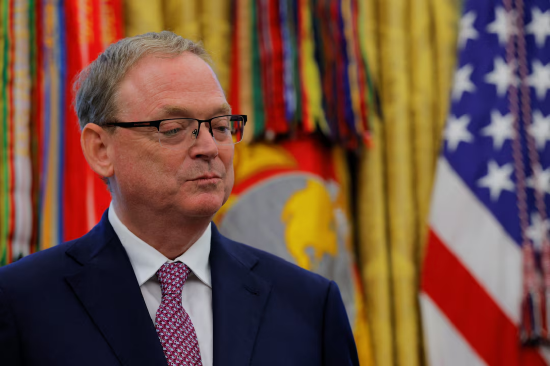
Hassett: U.S. Rate Cuts Lag Far Behind Other Central Banks
Kevin Hassett, the White House economic advisor and a prominent candidate for the Federal Reserve Chairman, recently stated that the pace of rate cuts in the U.S. significantly lags behind other major global central banks. Despite the U.S. economy's strong performance in the third quarter, exceeding market expectations, Hassett believes that the Federal Reserve's rate-cutting process is far from rapid. He notes that while other central banks have accelerated their rate cuts, the U.S. is noticeably falling behind.
In an interview, Hassett described the robust GDP data for the U.S. in the third quarter as "an excellent Christmas gift for the American people." According to the U.S. Department of Commerce, the real GDP growth rate in the third quarter reached 4.3%, far surpassing the market expectation of 3.2%. Hassett attributes 1.5 percentage points of this increase to President Trump's tariff policy, which he believes helped reduce the U.S. trade deficit.
Factors Driving U.S. GDP Growth
Hassett emphasized that of the 4.3% GDP growth in the third quarter, 1.5 percentage points can be attributed to Trump's tariff policy. He argues that the tariff policy narrowed the U.S. trade deficit, thereby facilitating economic growth. Nonetheless, Hassett points out that the strong performance of the U.S. economy has not yet prompted the Federal Reserve to accelerate rate cuts. He believes that the Fed needs to adopt more aggressive policies to address potential inflation pressures and challenges of economic slowdown.
AI Driving Economic Growth
Discussing the future of the U.S. economy, Hassett noted that the rapid development of artificial intelligence is driving economic growth while helping to curb inflation. He believes that AI applications have improved productivity, fostered innovation across U.S. industries, and boosted economic growth. Simultaneously, AI has also reduced costs, helping to suppress price pressures.
Hassett asserts that the boom in AI will inject new momentum into the U.S. economy, further enhancing its global competitiveness. As AI technology becomes more deeply integrated, the U.S. will continue to maintain a dominant position in the global economy.
Future Employment Growth Forecast
Regarding the future employment market, Hassett stated that if the U.S. economy continues its strong growth trajectory, monthly employment growth will return to the range of 100,000 to 150,000. He noted that with sustained economic growth, the job market will gradually stabilize, and unemployment rates might remain at historically low levels. Despite global uncertainties, Hassett remains optimistic about the U.S. job market.
However, he also cautioned that future employment growth will be affected by the Federal Reserve's monetary policy and global economic conditions. If the Fed adopts appropriate monetary easing measures, the U.S. economy will be able to maintain a healthy growth pace.
Conclusion
Hassett's remarks once again highlight the Federal Reserve's cautious stance on economic policy and recommend accelerating the rate-cutting process. Despite the strong performance of the U.S. economy in the third quarter, Hassett believes that the Fed should speed up rate cuts to address potential inflation pressures and economic slowdown. Future Fed monetary policies will be adjusted in light of global economic and domestic data.

