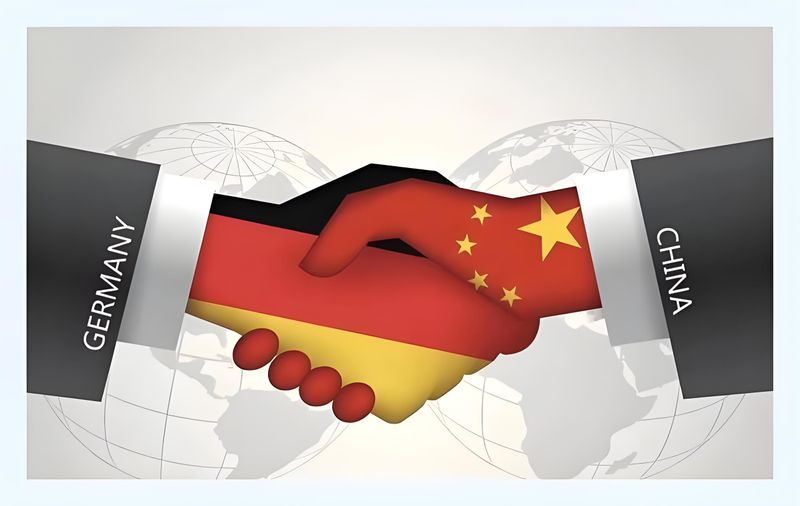
Sino-German Economic Relations Move Beyond the "Honeymoon Period"
For many years, China and Germany have been seen as "golden partners" economically. German companies have leveraged their technological advantage to enter the Chinese market, while Chinese enterprises have rapidly grown by relying on Germany's engineering systems. However, as China moves up the global value chain, this traditional mutually beneficial relationship is gradually shifting.
Data shows that the share of high-tech products exported from China to the EU jumped from 51% in 2000 to 73% in 2022, whereas Germany's share fell to 61% during the same period. This indicates that China is no longer just a learner in Germany's key industries but has become an emerging competitor.
Germany Faces Strategic Division and Realignment Pressure
In response to this change, Germany's policy has turned towards attempts with more protectionist hues, such as raising tariffs and restricting foreign investment. However, due to internal disagreements, particularly within the ruling coalition between the Social Democratic Party and the Christian Democratic Union regarding China, Germany has not yet formed a unified strategic approach.
Nevertheless, the latest coalition agreement demonstrates a more pragmatic orientation, acknowledging the necessity of continuing cooperation with China on global issues and shared interests, opening up new possibilities for Sino-German relations.
Divergent Business Attitudes: Large Corporations Entrench, Small Companies Cautious
The attitude of the German business community towards the Chinese market has become noticeably divided. Large companies like Volkswagen and BASF continue to increase their investment in China, frequently reinvesting their profits there, especially deepening their focus on electric vehicles and localized production. A survey from the Chinese German Chamber of Commerce reveals that 92% of German companies plan to continue developing "in China, for China."
In stark contrast, German small and medium-sized enterprises (SMEs) are increasingly cautious. While they still heavily rely on Chinese supply chains, facing competition from Chinese firms in end products, they generally advocate for "de-dependence" to mitigate potential risks.
External Pressures Force Germany to Seek Balance
Apart from the intensifying competition between China and Germany, Germany also needs to address uncertainties from across the Atlantic. The trade policies of the Trump administration have introduced new challenges to German-American relations, compelling Germany to seek more strategic cooperation space among its existing partners.
In this context, Germany urgently needs to clarify which industries have room for continued beneficial cooperation with China and which sectors should establish protective barriers to ensure its economic security and competitiveness.
China Remains an Irreplaceable Partner
Despite the challenges, China remains a crucial market that German companies cannot ignore, particularly in innovative fields such as battery technology and software integration, where China is setting new benchmarks. Meanwhile, China continues to view Germany as an important reference for operating standards and institutional innovation, eager to open up the European market for mutual benefit.
This provides an opportunity for a renewed and upgraded relationship between China and Germany. In the future, the two countries can establish cooperation platforms and R&D clusters in key fields like electric vehicles, hydrogen energy, and artificial intelligence, replacing traditional models with new complementary relationships.
Seeking New Opportunities for Collaboration Amid Competition
In the current reshaping of the global industrial landscape, Sino-German relations must also evolve accordingly. Germany still possesses top-notch engineering and professional expertise, while China is rapidly catching up in emerging technology fields. Only by pragmatically and rationally re-planning the cooperation direction can the two countries achieve a truly meaningful "win-win new situation" in the future.