
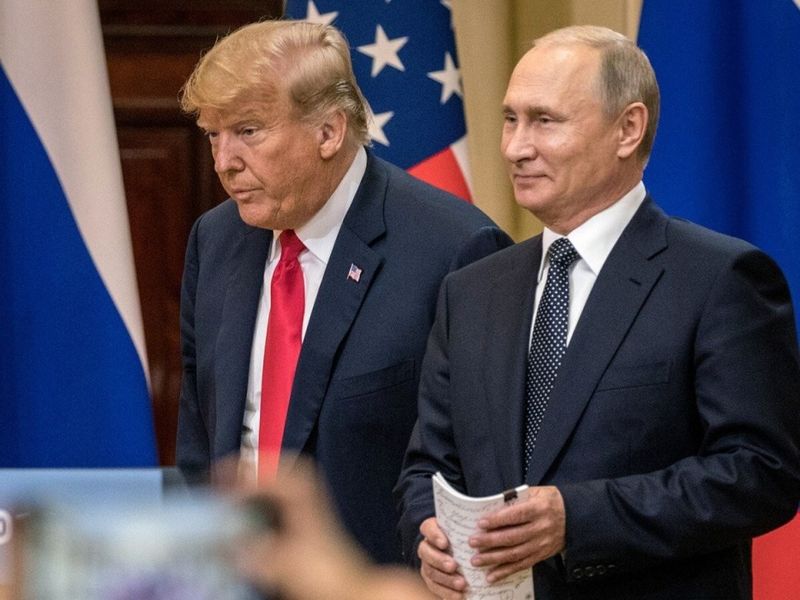
Escalating Diplomatic Signals: Trump's Statement of "Significant Progress"
U.S. President Trump has unusually described issues related to Russia as "significant progress" on his social platform, inviting the public to "stay tuned." This wording is seen as a continuation of recent high-level interactions, aimed at solidifying a dialogue atmosphere and leaving political space and flexibility for the next step of multilateral coordination.
Path Choices After the Alaska Meeting
In the Alaska talks, the U.S.-Russia dialogue was rated as "positive" by both sides, but no conclusion was reached regarding ceasefire and specific arrangements. Although no concrete documents were produced, the level of communication and the broadness of topics expanded, laying a foundation for subsequent negotiations. Analysts say that post-meeting information management has become more cautious, indicating that both sides are evaluating the minimum consensus that can be implemented.
Tri-Party Talks and the Increasing Role of Europe
Ukrainian President Zelensky has confirmed a scheduled meeting with Trump, putting the idea of trilateral talks into the technical assessment phase. Germany has proposed hosting the talks in Europe, intending to provide a geographically and politically "neutral ground." European countries hope to participate in agenda design as hosts and guarantors, to prevent security concerns from being marginalized.
Rubio's Bottom Line: Peace Built on Mutual Compromise, Not Unilateral Actions
U.S. Secretary of State Rubio emphasized that advancing peace talks requires realism and resilience, and any lasting arrangement must include mutual concessions. He noted that while potential convergence points have been identified, "there is still a long way to go" to ceasefire. This statement downplays short-term over-optimism while confirming a technical route of building trust through phased achievements.
Points of Entry and Constraints: The Challenging Puzzle from Security to Sovereignty
Potential points of entry might involve battlefield de-escalation, personnel exchanges, humanitarian corridors, and protection of critical infrastructure; deeper issues involve security boundaries, sovereignty definitions, and monitoring mechanisms. Any textual arrangement must simultaneously consider implementation and verification tools and fallback clauses in case of failure, to avoid structural risks hindering agreement implementation.
Multilateral Participation and Rebalancing of Security Arrangements
Europe's involvement aims to provide security guarantees and resource coordination; meanwhile, multilateral institutions can play roles in monitoring and assistance stages. How to introduce third-party guarantees while ensuring Ukraine retains its main position is the key to negotiation design. If a "phased—reversible—verifiable" framework can be established, the resilience of the agreement will be significantly enhanced.
Market and Security Impacts: Short-term Optimism, Long-term Caution
Elevated diplomatic expectations often lead to a rise in risk preference, but the market remains sensitive to "unexpected events" in the absence of a clear ceasefire mechanism. Fluctuations in energy, food, and safe-haven assets may adjust with repeated negotiation news, and the clarity of policy communication will directly affect expectation stability.
Subsequent Observations and Time Windows
The focus should be on three aspects: first, whether the meeting between Trump and Zelensky produces a replicable agenda list; second, the location, form, and level of participation in the trilateral talks; third, whether actionable trust measures (ceasefire trials, humanitarian corridors, third-party supervision) emerge. If these elements gradually take shape in the coming weeks, the "engineering advancement" of the peace process could truly begin.

