

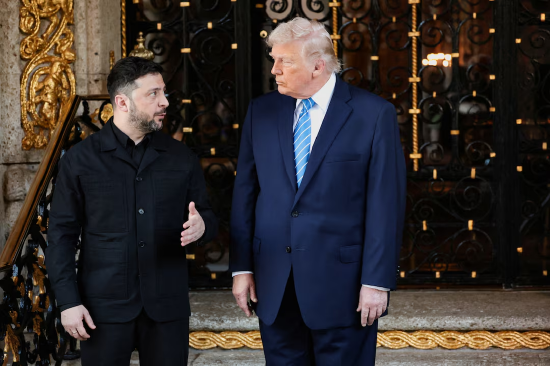
Three-Hour Key Discussions at Mar-a-Lago
On December 28th, local time, Ukrainian President Volodymyr Zelensky arrived in Florida, USA, for a three-hour closed-door meeting with US President Donald Trump at Mar-a-Lago. The meeting aimed to finalize a substantial framework to end the Russia-Ukraine conflict. In a subsequent joint press conference, Trump stated that significant progress had been made on the "20-Point Peace Plan," with about 95% consensus reached, though "one or two very difficult" issues remained unresolved.
One of Zelensky's primary objectives for visiting the US is to seek amendments to the current peace proposal concerning the Donbas region. The current version of the proposal leans towards a complete withdrawal of Ukrainian forces from the eastern Donbas region, which is a core demand of the Russian side. Ukraine fears that accepting this entirely would mean relinquishing strategic territories still under Ukrainian control.
US and Russian Presidents’ Call Precedes Meeting
Just before Zelensky's motorcade arrived at Mar-a-Lago, Trump had a call with Russian President Vladimir Putin. Trump described the call as "productive," while Russian foreign policy advisor Yuri Ushakov described it as "friendly and cordial." This direct communication, prior to the US-Ukraine meeting, is seen as Putin setting "red lines" directly with Trump.
Ushakov revealed that Putin firmly opposes the "60-day temporary ceasefire plan" proposed by the EU and Ukraine, believing that such a short intermission would not resolve fundamental conflicts and might prolong the war. Russia insists that Ukraine must make an urgent decision on the withdrawal from Donbas. Additionally, Russia and the US have agreed to establish two working groups, focusing on security issues and economic affairs, indicating Russia's attempt to steer the resolution framework towards areas suiting its interests.
Final Game of Sovereignty and Security Guarantees
Although the meeting atmosphere was described as "good," the final status of the Donbas region and the security guarantee mechanism remains the biggest stumbling block to signing an agreement. Zelensky emphasized that Ukraine requires "ironclad" security guarantees, including defense commitments similar to those among NATO members, to prevent Russia from launching another offensive after the agreement is signed. However, Trump has previously expressed a preference for both sides to "stop at the current lines," a stance perceived by Ukraine and some of its European allies as a tacit acknowledgment of territorial concessions.
The current "20-Point Plan" was derived from a previously more Russia-leaning "28-Point Plan." Zelensky disclosed that documents regarding security guarantees are close to 100% agreement, but the sequence of territorial withdrawals and exact boundary lines will require several more weeks of discussions. Trump stated that he would further communicate with European and NATO leaders in the coming weeks and does not rule out the possibility of holding a US-Russia-Ukraine trilateral meeting. As the clock ticks towards 2026, this peace relay, crucial to the future landscape of Europe, enters its most intense phase.

