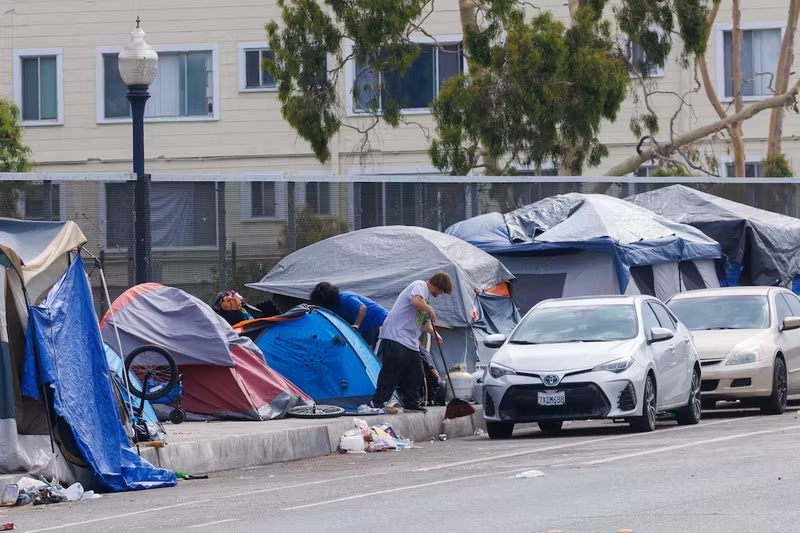
Nationwide Camp Cleanups: Executive Order Sparks Widespread Reaction
In July 2025, U.S. President Trump signed a controversial executive order directing state and city governments to take measures to clear homeless encampments and encourage individuals to enter treatment facilities. This order quickly became a societal focal point, sparking widespread political controversy and legal and ethical discussions.
The order marks a shift toward a more aggressive and centralized federal strategy in addressing homelessness. While the White House claims it will improve public health and city appearances, critics warn that the executive order could lead to the forcible eviction of the homeless, or even involuntary treatment.
Supreme Court Ruling Paves the Way for Policy
Trump's move follows a key 2024 U.S. Supreme Court ruling. This ruling allows local governments to legislate the restriction of homeless encampments in public areas, even without alternative housing provisions. The ruling provided the Trump administration with the legal groundwork to push for national camp clearing measures.
Based on this, the executive order further authorizes the Attorney General to challenge existing state and federal legal protections. However, it remains unclear how the Department of Justice will navigate existing legal obstacles, especially with a lack of broad support within the federal court system.
Human Rights Groups and Experts Strongly Criticize
Several human rights and social welfare organizations have openly condemned the implementation of the executive order. The National Law Center on Homelessness and Poverty (NLCHP) warns that the order fails to provide any stable housing solutions and may criminalize homelessness through enforcement mechanisms.
“This is not a solution to the problem, but rather pushing the issue into a deeper humanitarian crisis,” the NLCHP statement noted. Similar sentiments have quickly spread nationwide, particularly in West Coast cities like Los Angeles and San Francisco, already grappling with severe housing crises.
The Predicament Behind the Numbers
According to federal agency statistics, the homeless population in the U.S. was nearing 770,000 in 2024, an 18% increase from the previous year. More than one-third of these individuals live in cars, tents, or on the streets, indicating a severe shortage of available temporary shelter resources.
Though the Trump administration advocates “guiding” these individuals into mental health and addiction treatment facilities, it has not simultaneously introduced policies to increase treatment capacity or enhance housing support. This has led to skepticism that the order is more of a “political exhibition” than a structural reform.
Social Tensions May Further Escalate
On the flip side of the policy, there is public anxiety regarding urban order and residential safety. Some citizens support clearing encampments, believing the homeless affect city appearances and public health. However, in the absence of alternative accommodation options, these clearing actions often result in enforcement-driven evictions, thereby exacerbating social tensions.
Several legal experts note that, against the backdrop of current budget cuts, such orders will struggle to have a lasting impact unless supported by funding and social service mechanisms, and may even face constitutional challenges.
Future Policy Direction Faces Tests
The Trump administration's approach demonstrates its tough stance on urban management and homelessness but also highlights the federal government's dilemma in balancing humanitarian policy with social equilibrium. Whether state governments choose to actively respond or resist remains to be seen.
Meanwhile, with the presidential election approaching, this order is highly likely to become a new focal point in partisan debates and will serve as a key factor for the public in evaluating candidates' social policy philosophies.