
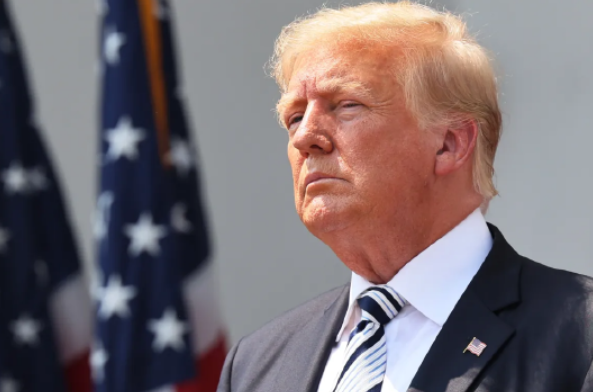
Trump States "Powell Will Leave in Eight Months"
On July 23rd local time, US President Trump made a rare direct mention of Fed Chair Powell during a meeting with the President of the Philippines, stating that Powell's performance was "poor" and predicting that he would step down "in eight months." Although Powell's official term extends to May 2026, Trump's comments have triggered speculation that the Fed's leadership might face an early change.
These remarks not only reignited concern over the Fed's political neutrality but were also interpreted as Trump positioning for future monetary policy moves, amid the simultaneous pressures of tariff policies and calls for rate cuts.
Fake Resignation Letter Causes Short-Term Fluctuations
Just before Trump's comments, a forged "Powell Resignation Letter" quickly circulated on social media. Although regulators promptly confirmed it as fake and revealed AI-generated traces, it temporarily caused fluctuations in Treasury yields and the dollar, highlighting market sensitivity to Powell's situation.
Analysts noted that the frequency of such incidents reflects growing investor concerns about policy stability, especially in the context of Trump's repeated statements pressing for rate cuts. Powell's term stability has become a key market variable.
Fed Independence in Focus as Interest Rate Curve Strategy Reshuffles
With expectations of political intervention rising, institutions are adjusting based on potential deviations in the interest rate path. Deutsche Bank suggests "curve steepening" trades—long short-term Treasuries and short long-term ones—to hedge against the dual risks of the Fed being forced into early rate cuts and long-term inflation expectations rising.
Recent data shows the 5-year and 30-year US Treasury yield spread nearing 100 basis points, a high since 2021. The 30-year yield at one point reached 4.94%, reflecting growing concerns about future fiscal deficits and inflation pressure in market prices.
Goldman Sachs also pointed out in its report that market inflation expectation indicators and the 2-year rate movements have shown a clear divergence, revealing investor caution about the potential loosening of the "monetary anchor."
Diverging Market Expectations Make Fed Operations More Cautious
Although Trump has called for cutting the federal funds rate below 1%, mainstream market institutions remain cautious about the rate cut path. Goldman Sachs expects the Fed to cut by 25 basis points in September and three more times within the year, but if political pressure continues to increase, the Fed may delay rate cuts or limit their extent to maintain policy independence.
Moreover, the interest rate swap market suggests a roughly 56% probability of a rate cut at the September meeting, reflecting trader uncertainty about the policy direction.
Fed officials have recently started emphasizing the "data dependence" approach to avoid political entanglements. Observers believe that if the market continues to interpret White House actions as deeper Fed intervention, it could weaken confidence in the dollar and lead to more dramatic repricing in the bond market.
Tariff Negotiations and Powell's Fate Present Dual Challenges for the Market
It's notable that August 1st is the deadline set by Trump for trade negotiations related to tariffs on Japan and South Korea. If negotiations fail, the Fed might face stronger political calls to cut rates. Combined with uncertainty surrounding Powell's position, this timing will become a "high-risk window" for capital markets.
Analysts point out that the coexistence of policy uncertainty and political risk will lead investors to increasingly turn to short-duration assets and safe havens like gold. Since July, the 30-year US Treasury yield has surged, and futures trading volumes have risen sharply, all reflecting market preparations for the "Fed independence weakening + fiscal expansion" scenario.
Powell's Position Becomes a Market Focal Point
Given the current situation, whether "Powell's exit" materializes or not, his personnel fate has already become a key variable in market dynamics. If in the future the Fed is practically controlled by executive forces, it will reshape inflation expectations and trigger capital outflows and dollar volatility.
The market should closely monitor Trump's ongoing statements about the relationship between the White House and the Fed and whether Powell signals stability in his upcoming monetary policy meetings to stabilize expectations. It is foreseeable that the intertwining of politics and economics is complicating macro calculations in 2025, with the Fed, as the world's most crucial central bank, undoubtedly being a weathervane for global financial sentiment.

